
Hunting Without Fear: Why Even Experienced Hunters Shake Before the Shot
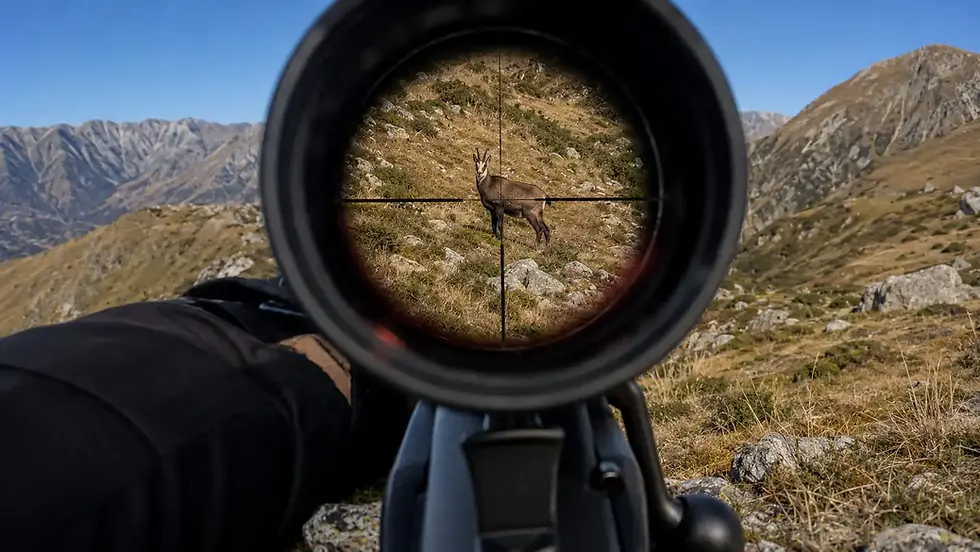
The buck is standing broadside. The distance is right. The rifle is steady on the rest. Everything should be perfect. Then your pulse spikes. Your hands begin to tremble. And somehow the trigger feels heavier than it did just a few minutes ago. Almost every hunter knows some version of buck fever. But when does healthy excitement turn into anxiety? And why can even decades of hunting experience fail to protect us from it? Nika, huntress and psychologist for Shot & Stillness, explains what happens inside our heads when the moment of truth arrives.
Maybe there are five seconds left.
Your finger rests on the trigger. Through the scope, the animal is standing still. You have sighted in the rifle. You know the range. You have practiced the shooting position hundreds of times. And yet something happens that cannot be explained by the quality of your rifle—or the number of years you have hunted.
Your heart rate climbs. Your breathing becomes shallow. The reticle begins to wander. Then one thought enters your mind: Don’t screw this up.
And that is often where the trouble starts.
“Many hunters believe that feeling nervous before the shot means they lack experience or confidence. That simply isn’t true,” says Nika. “The body is reacting to a situation that carries enormous importance for us. And precisely because that shot matters, our level of arousal rises.”
When a Stag Sends Your Heart Rate Through the Roof
Buck fever is more than an old hunting-camp story. It can actually be measured. Researchers followed 19 men and women during a real deer hunt and continuously recorded their cardiac activity. Fifteen of the 19 hunters experienced what English-speaking hunters commonly call buck fever—an intense burst of acute physiological arousal when game appeared or immediately before the shot. In seven hunters, heart rate briefly reached at least 85 percent of their age-predicted maximum.

What makes that remarkable is that the hunter does not have to be physically active at all. He may have been sitting motionless in a stand for several minutes, yet his body suddenly reacts as though someone flipped a switch.
Stress hormones are released. The heart beats faster. Blood flow to the muscles increases. Attention and perception begin to change. The body prepares for action.
“From an evolutionary standpoint, that response makes perfect sense,” Nika explains. “Our nervous system first asks: Is this situation important? Do I need to react? Only afterward does our conscious mind interpret what is happening. That’s why intense excitement, joy and fear can feel surprisingly similar in the body.”
Buck fever, then, is not weakness. Quite the opposite. If an old chamois buck still makes your pulse jump after decades of hunting, that does not automatically mean you have a psychological problem. Maybe hunting simply still means something to you.
The Ten Seconds That Matter Most
What happens immediately before the shot may be even more interesting. In an experimental hunting simulation involving 60 hunters, researchers studied pupil response, skin conductance and participants’ subjective perception of time. Physiological arousal began as soon as the first deer appeared. During the ten seconds immediately before the shot, electrodermal activity increased significantly.
Even more striking: time appeared to slow down. Many hunters know the sensation. A sequence that lasts only a few seconds in real time can remain in memory as though it unfolded in slow motion. The animal steps out. It pauses. It turns. The reticle settles behind the shoulder. And eventually the rifle fires.
“Under high levels of arousal, our perception changes,” says Nika. “Attention can narrow dramatically onto individual stimuli. That isn’t necessarily a bad thing. It becomes a problem when the hunter stops processing the entire situation and starts thinking only: I have to shoot now.” That single sentence carries enormous weight in hunting. Because in the hunter’s mind, a possible shot has suddenly become a necessary shot.

The Most Dangerous Thought: “I Cannot Miss”
This is where buck fever can turn into performance anxiety. An experienced hunter knows how to shoot. Position, breathing, trigger control and follow-through have been repeated for years. Much of the process happens automatically, without consciously directing every muscle.
But the more important the moment feels, the stronger the temptation becomes to suddenly take conscious control of an action that normally runs on instinct and routine.
Am I really steady?
Is the reticle exactly where it belongs?
Am I pressing the trigger cleanly?
What happens if I miss?
Suddenly, the hunter begins thinking about movements his body already knows how to perform. Sports psychology has documented a related phenomenon in archery known as target panic. Experienced archers can suddenly become unable to execute movements that previously felt completely automatic. In one qualitative study, seasoned archers described a recurring cycle: their attention shifted increasingly toward the outcome of the shot. That created a stronger desire for control—which ultimately led to a loss of control.
“The more I tell myself that I absolutely cannot miss, the more important the possibility of missing becomes in my mind,” Nika explains. “The brain is no longer focused on executing the process correctly. Instead, it becomes occupied with a possible negative outcome. And that creates additional pressure.”
One bad shot can reinforce the pattern—especially when it is followed by a difficult or unsuccessful search for wounded game.
When a Bad Shot Follows You Into the Stand
Hunters talk endlessly about calibers, bullets and shot placement. They talk far less about this. An animal was wounded. The tracking job lasted for hours. Maybe it was recovered the next morning. Maybe it was never recovered at all. The next time the hunter climbs into a stand, he is no longer sitting there alone. The memory is sitting beside him.
Similar performance blocks are known from several sports. They can involve severe anxiety, a feeling of freezing up and an inability to perform movements that were previously automatic. Sports psychology also cautions against overly simple explanations. These blocks can involve different psychological, physiological and, in some cases, neurological mechanisms.
For hunters, the lesson is straightforward: Not every tremor is fear. Not every poor shot creates a mental block. But repeated thoughts about a previous mistake can absolutely influence the next shot.
“Our brain learns associations very quickly,” says Nika. “If a particular situation becomes linked to an especially stressful experience, the next similar moment may immediately trigger the thought: I hope that doesn’t happen again. And that anticipatory anxiety creates tension all over again.”
A vicious cycle can develop. The hunter wants to make an especially clean shot. So he tries to control everything more intensely. Because he is controlling everything, he notices every tiny movement. That makes him less confident. And because he feels less confident, he tries to control even more.
Why Experience Still Matters
There is good news: experience makes a difference. Just perhaps not in the way many hunters assume. In one study involving 127 armed British police officers, researchers compared less experienced shooters with seasoned marksmen under increased performance pressure. The less experienced shooters showed higher anxiety levels and heart rates, while their accuracy declined. The experienced shooters also showed a substantial rise in heart rate—but they were much better able to maintain their shooting performance.
Put simply: The professional does not necessarily have a lower pulse. He simply shoots better with a high pulse.
Research into visual attention during aiming supports the same idea. Scientists use the term Quiet Eye to describe the final stable visual fixation on a relevant target area immediately before a decisive movement. In many precision tasks, longer and more stable fixation is associated with improved performance. Anxiety, on the other hand, can shorten that phase.
The difference between an elite performer and a beginner is therefore not just mechanical skill. It is also about where attention remains when pressure rises. “Routine doesn’t mean you stop feeling excitement,” says Nika. “Routine means you can still access a familiar process while you are excited.”
Stop Fighting the Shakes

So what should you do when the buck steps out and your knees suddenly feel weak? Perhaps something unexpected:
Don’t fight it. At least not by telling yourself: This must not be happening.
“If I notice that my heart is beating faster and at the same time tell myself I absolutely have to calm down, I create a second stressor,” Nika explains. “Now I’m not only dealing with the hunting situation. I’m also fighting my own physical reaction.”
A better approach is to notice the arousal without immediately judging it.
My heart rate is high.
Fine.
I’m excited.
Fine.
Now return to the process.
Breathe.
Build the position.
Find the target.
Press the trigger.
Or:
Don’t shoot.
Because part of a stable shooting process is also knowing when to stop it.
The Most Important Shot May Be the One You Never Take
This is one of the fundamental differences between hunting and competitive shooting. At some point, the competitive shooter has to fire. The hunter does not. The animal can walk away. The buck may be there tomorrow. That stag may never be taken this season at all.
“The ability to consciously decide not to shoot is psychologically incredibly important,” says Nika. “If a hunter believes he has to capitalize on every good opportunity, he becomes dependent on the outcome. But once he understands that aborting the shot is always possible—and perfectly acceptable—it removes a great deal of pressure.”
That is also why hunting practice should involve more than shooting tiny groups from a bench. Hunters should practice from multiple field positions. With an elevated heart rate.
After physical exertion. Under time pressure. From shooting sticks. Off a backpack.
Prone, seated or braced against a tree. And they should also practice lowering the rifle.
Reassessing the situation. Then mounting the rifle again only if the shot still makes sense.
Can Breathing Techniques Help?
Breathing exercises are frequently recommended in shooting sports. That advice is not entirely wrong—but don’t expect miracles.
In a randomized study involving 67 participants, five minutes of slow diaphragmatic breathing before a pressured shooting task reduced certain aspects of self-reported cognitive anxiety. It did little, however, to improve heart rate or actual shooting performance.
So once again, there is no psychological trick that can replace training. Breathing may help regulate arousal. But the foundation remains a repeatable shooting process. Nika sums it up in one sentence: “The calmest hunter is not automatically the best shot. The better hunter is the one who still knows exactly what to do when he isn’t calm.”
Keep a Little Buck Fever

Maybe our goal should not be to hunt completely without fear. Because hunting without any emotion at all would probably mean losing part of what makes it hunting in the first place. Your heart is allowed to beat faster when, after hours of glassing a distant mountainside, the old chamois buck finally stands up.
Your hands are allowed to shake when, after three empty mornings, the mature stag finally materializes out of the fog.
What matters is something else. The excitement does not make the decision. The hunter does. He knows when the shot is responsible. And just as importantly, he knows when to take his finger off the trigger.


Comments