
Mauser 98: Why This Rifle Still Sets the Standard After 125 Years
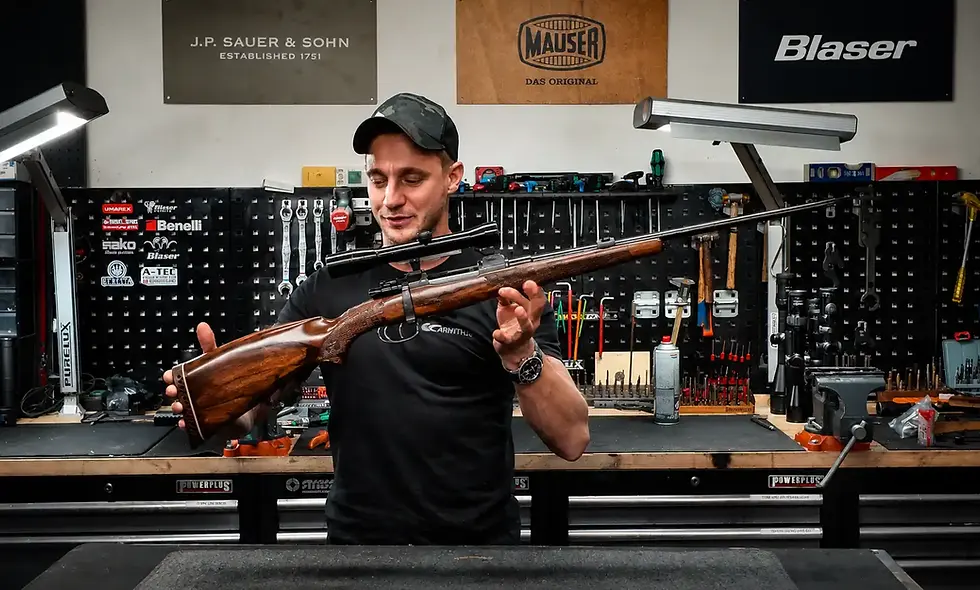
Some hunting rifles come and go. Others define an entire era. The Mauser 98 belongs firmly in the latter category. For Shot & Stillness, firearms expert David of Alpen Adria Jagd in Villach takes a close look at a classic Ferlach sporting conversion—and explains why this supposedly outdated design is anything but obsolete.
There is no carbon-fiber barrel on the table. No detachable box magazine. No digital clip-on optic.
Instead, there is steel. Walnut. An old four-power scope. A fixed internal magazine, a German double-set trigger and a bolt-action design officially adopted as a German military rifle in 1898. And yet, nothing about it feels like a museum piece.
The Mauser 98 is a reminder that progress does not always mean starting over. Some mechanical solutions are so sound that later generations can do little more than refine them, simplify them or adapt them to modern manufacturing methods.
“It is a legend almost everyone knows,” David says. “Extremely reliable, proven all over the world, manufactured by the millions and copied just as many times.”
Modern manufacturers still like to describe the Model 98 action as the ancestor of today’s bolt-action rifle. More than 125 years after its introduction, new sporting rifles are still being built around the same basic design—from comparatively plain working rifles to lavishly engraved bespoke guns.
From Military Rifle to Ferlach Sporting Arm
The Gewehr 98 was officially adopted by the German Empire on April 5, 1898. Developed under the direction of Paul Mauser, it was created in response to the shortcomings of earlier military rifles. Its rugged action, fixed box magazine and generous safety margins established a new benchmark for bolt-action design.
Its history is inseparable from the two world wars. But reducing the Model 98 to its military service would overlook its broader importance. Sporting and target rifles based on the action appeared early on, and after the wars, countless military receivers were transformed into hunting rifles by skilled gunsmiths.
In Europe’s traditional gunmaking centers, many of those conversions ended up bearing little resemblance to the original service rifle. New barrels, carefully shaped stocks, set triggers, sporting safeties, scope mounts and engraving turned former military arms into highly individual hunting rifles.
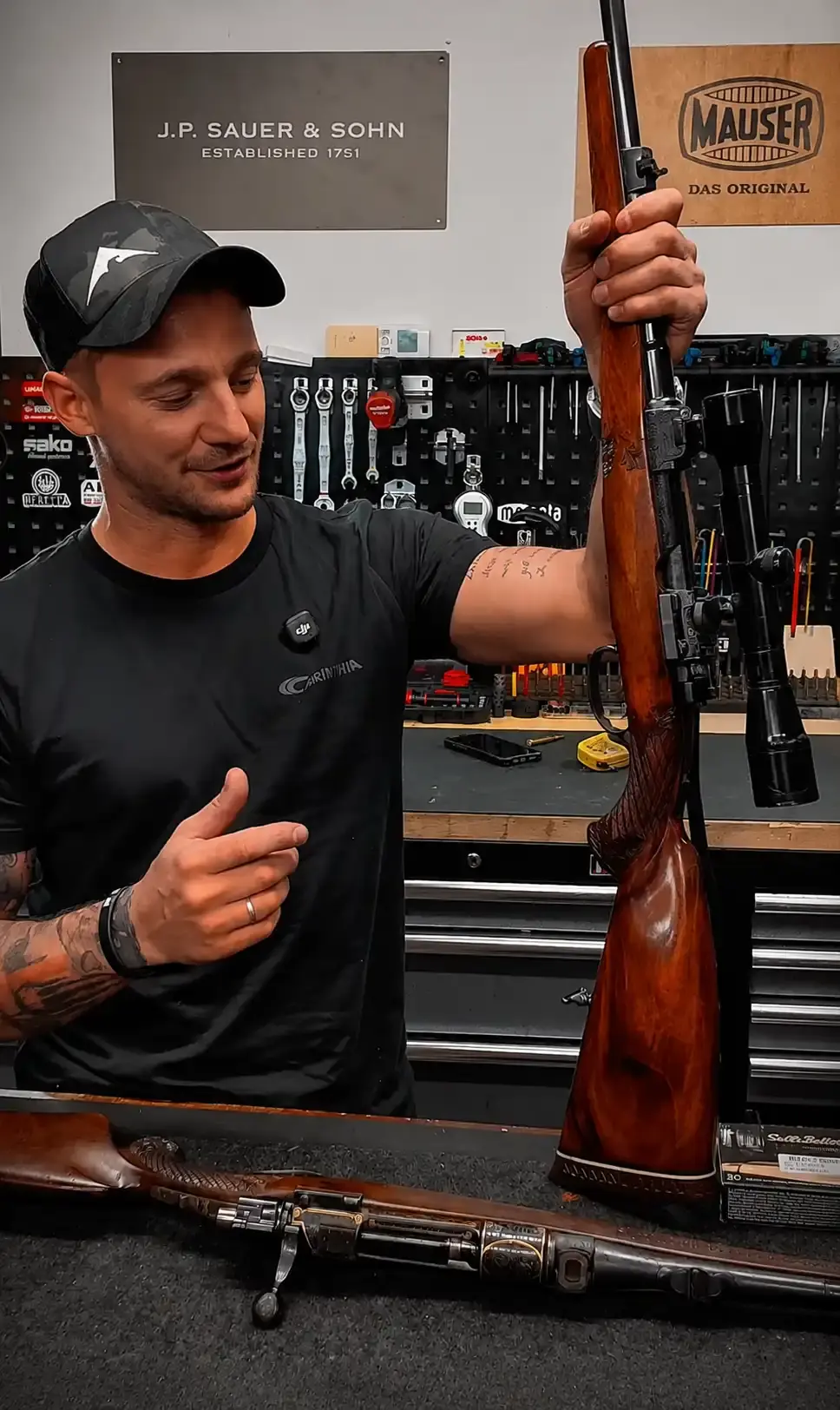
That is exactly the kind of rifle David is holding.
In his assessment, this military Model 98 action was converted into a sporting rifle in 1968. The barrel was made in Ferlach, Austria, one of Europe’s most respected gunmaking centers. The rifle wears a traditionally styled walnut stock with a slight hogback comb, Bavarian cheekpiece, fine checkering and a ventilated rubber recoil pad.
“There is a tremendous amount of work in a rifle like this,” David explains. “Converting a military action properly into a clean, accurate sporting rifle takes time. That is also why high-quality Mauser conversions can cost serious money.”
The Mauser 98 world stretches from affordable former military rifles to newly manufactured luxury bolt guns. A current Mauser 98 Standard Expert, for example, is offered with a newly made action, steel magazine floorplate and high-grade walnut stock. Its list price starts at more than 13,000 euros.
Bespoke rifles with custom engraving, exceptional stock blanks and extensive handwork can cost far more. The underlying action remains fundamentally the same. The difference lies in material selection, fit, finish, engraving, stock work and, above all, the number of hours invested by the gunmaker.
Two Lugs Carry the Load - The Third Waits for Trouble

The heart of the Mauser 98 is its bolt action. Two massive locking lugs sit at the front of the bolt and absorb the forces generated during normal firing. A third lug is positioned farther back. Under ordinary conditions, it carries no load. Its job begins only if the primary locking system should fail.
“The third lug is my backup,” David says.
That additional safety lug was one of the major improvements over earlier Mauser actions. The design also incorporates gas-escape ports in the bolt and a substantial gas shield at the bolt shroud. In the event of a serious primer or case failure, hot gas is intended to be directed away from the shooter’s face and, among other paths, down toward the magazine well.
David knows from unpleasant personal experience how valuable those safety margins can be. About 15 years ago, an obstruction remained in one of his rifle barrels and caused a massive overpressure event. The magazine floorplate blew out and the stock broke, but David was not injured.
Today, he tells the story with his usual dry humor. It should not, however, be taken as encouragement to test the limits of any rifle. If there is even the slightest suspicion of a bore obstruction, defective cartridge or abnormal report, the firearm must not be fired again. It should be unloaded and inspected by a qualified gunsmith.
The Mauser 98’s safety features are impressive. They are no substitute for proper handling or a professional inspection of an older firearm.
Controlled-Round Feed: The Cartridge Never Gets Away

One of the defining features of the Mauser 98 is its controlled-round-feed system.
As the bolt moves forward, the cartridge rises from the magazine and its rim slides beneath the long extractor claw. From that point onward, the cartridge is mechanically controlled by the bolt. It is not simply pushed loose into the chamber. It remains captured throughout the feeding cycle.
The long extractor engages the cartridge before the bolt is fully locked. When the action is opened, the extractor pulls the case from the chamber. At the rear of the action, the case strikes the fixed ejector and is thrown out to the side.
“That is exactly what makes these actions so reliable,” David says.
Mauser continues to emphasize the combination of a long claw extractor and controlled-round feed. The system is particularly valued on dangerous-game rifles because it is designed to feed and extract reliably during rapid cycling, from awkward shooting positions and under difficult field conditions.
A traditional Model 98 should generally be loaded from the magazine. If a cartridge is simply dropped into the ejection port and the bolt is closed over it, the extractor claw must snap over the case rim. Some modified actions tolerate this better than others, but feeding from the magazine is the method for which the classic action was designed.
A Magazine You Cannot Leave at Home

David is a strong supporter of fixed internal box magazines.
His reasoning is simple.
“You cannot lose the magazine, and you cannot leave it at home.”
Cartridges are pressed into the fixed magazine from above. The original military rifle could be loaded with stripper clips, and the corresponding receiver cutout can still be seen on many sporting conversions.
The rifle shown here has a hinged floorplate. This allows the cartridges to be removed through the bottom of the magazine without cycling every round through the action.
On many military Model 98 rifles, the follower also prevents the bolt from closing once the magazine is empty. For a soldier, this provided immediate feedback that the final round had been fired. To close the empty action, the follower must be pressed down slightly.
The modern standard Mauser 98 still uses a top-loading fixed magazine, typically with a capacity of five rounds plus one in the chamber. Magnum versions generally carry fewer cartridges, depending on the chambering and model.
The Wing-Safety: Secure, but Not Scope-Friendly

Few components are as closely associated with the Mauser 98 as its large wing safety on the bolt shroud.
It acts directly on the firing pin and has three positions. With the lever to the left, the rifle is ready to fire. In the center position, the firing pin is blocked but the bolt can still be opened, allowing the rifle to be unloaded while on safe. In the right-hand position, both the firing pin and the bolt are locked.
From a mechanical safety standpoint, blocking the firing pin directly is a compelling design. When mounting a modern scope, however, the tall wing safety can create problems.
The rifle featured here carries an old fixed four-power Kahles Helia. There is very little room between the safety lever and the ocular housing. Larger scopes or optics mounted especially low may interfere with the original safety.
For that reason, many sporting conversions were—and still are—equipped with low-profile side safeties or alternative safety systems. These allow a scope to sit lower but alter some of the rifle’s original appearance.
For now, David wants to preserve the rifle’s traditional character.
“The old four-power scope suits the rifle,” he says. “I am not going to hunt beyond 100 meters with it anyway.”
A 90-Degree Bolt Lift - and a Swept Bolt Handle
The two front locking lugs require a 90-degree bolt lift. On military rifles with a straight bolt handle, the handle can strike a low-mounted scope when the action is opened.
For that reason, the bolt handles on classic sporting conversions were often bent, forged down or replaced. This creates clearance beneath the optic and also places the handle within easier reach during cycling.
At first glance, such work may appear simple. In reality, it demands experience, dimensional accuracy and a clean finish. On a historic conversion, small details such as these determine whether a rifle merely functions or feels like a complete and carefully executed piece of gunmaking.
German Double-Set Trigger: Roughly 3½ Ounces Between Finger and Shot
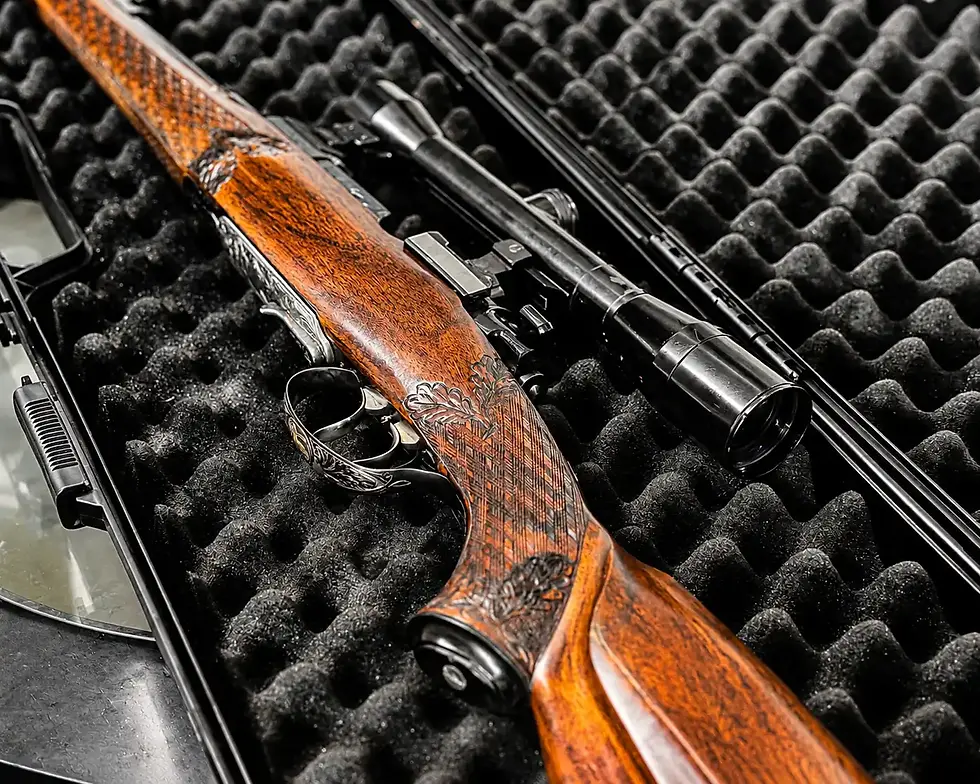
This rifle features a German double-set trigger. The rear trigger is used to set the mechanism, while the front trigger fires the rifle.
According to David, setting the trigger reduces the pull weight to approximately 100 grams, or about 3½ ounces.
A trigger this light can allow an exceptionally precise shot release, but it demands disciplined handling.
The trigger should be set only immediately before the intended shot. If the shot is not taken, the mechanism must be unset according to the design of the specific rifle and in strict compliance with safe gun-handling procedures.
Owners should avoid making trigger adjustments unless they have the required knowledge and experience. Older set triggers in particular should be inspected by a competent gunsmith. A trigger that is adjusted too lightly, contaminated or worn can present a serious safety risk.v
Old Scope Mounts and the Art of Zeroing
The mounting system beneath the old Kahles scope tells its own story of traditional European gunmaking.
Modern scopes typically provide both windage and elevation adjustments in the optic itself. On older systems, windage was sometimes corrected through the mount. The scope on this Ferlach Mauser has elevation adjustment only. Horizontal point of impact is corrected by fitting or shifting a wedge in the front mounting base.
What appears cumbersome today was once standard practice. A mount of this type had to be precisely fitted, soldered or screwed into place, and then properly regulated on the range. The labor involved helps explain why a handcrafted pivot mount or claw mount can still cost several hundred euros.
David raises another important point: Not every historic conversion is automatically safe.
On some older scope installations, material was milled from the receiver ring to accommodate a mounting base. If too much steel was removed or the work was poorly executed, the strength of the receiver may have been compromised. The concern is that later reinforcement plates or soldered bases can hide such modifications.
Anyone considering the purchase, reproofing or rechambering of an old Mauser should not judge the rifle by appearance alone. The action, barrel, locking surfaces, proof marks, scope-mount holes and any welding or soldering should be inspected by an experienced gunsmith or proof authority.
A 25½-Inch Barrel and a European Classic
The featured rifle has a barrel measuring approximately 65 centimeters, or 25½ inches, and is chambered in 7×64 Brenneke.
Wilhelm Brenneke introduced the 7×64 in 1917. As a rimless hunting cartridge, it was ideally suited to bolt-action rifles and went on to become one of the great European sporting cartridges, particularly in German-speaking countries.
Its combination of a relatively flat trajectory, broad bullet selection and sufficient power for much of Europe’s hoofed game made it popular with generations of hunters.
The long barrel suits the slim lines of the Ferlach rifle and also allows the cartridge to perform efficiently. David has no intention of cutting this particular barrel to accommodate a suppressor.
“On another working rifle, a conversion may make sense,” he says. “But this one should remain exactly as it is.”
Modernization can be appropriate on less collectible sporting conversions. New stocks, modern triggers, lower safeties, contemporary scope mounts and—after proper evaluation—a threaded muzzle are all possible. With a historic rifle, however, the practical benefit should always be weighed against the loss of originality and potential collector value.

On the Range: The Old Action Still Delivers
For the range test, David chooses the RWS Kegelspitz load with an 8-gram bullet, equivalent to roughly 123 grains.
From a 60-centimeter, or 23.6-inch, test barrel, the manufacturer lists a muzzle velocity of 965 meters per second, approximately 3,166 feet per second. From the Mauser’s 65-centimeter barrel, David’s chronograph records about 970 meters per second, or roughly 3,182 feet per second—a plausible result that closely matches the published figure.
The RWS Kegelspitz is a traditional cup-and-core soft-point design. In 7×64, it has long been offered in several bullet weights. David suspects the rifle may originally have been regulated in the 1960s with a similar load.
The first shots confirm that the old Mauser can still shoot. At 100 meters—about 109 yards—the group lands approximately 2 centimeters, or just under an inch, low.
Naturally, target definition through an old fixed four-power scope with a small objective lens is not comparable to that of a modern hunting optic. Even so, the rifle produces a group more than adequate for practical hunting.
David deliberately leaves the zero alone.
“I will shoot it only out to 100 meters,” he says. “If I hold high on the shoulder, it is right where it needs to be. Why start hammering on a rifle that already does exactly what it is supposed to do?”
That may be the most honest moment of the entire test. The Mauser 98 does not need to prove that it can compete with a modern long-range rifle. It does not need to print tiny groups at 500 yards or accept thermal clip-on optics.
This particular rifle will go into the field once or twice a year. Not because it does everything better, but because hunting with it feels different.
More deliberate. Slower. Perhaps even a little more meaningful.
Old Does Not Mean Obsolete
A Mauser 98 does not have to gather dust in a gun cabinet. The action still supports an enormous range of possible modifications. Stocks, triggers, safeties and mounting systems are available in numerous configurations. Gunsmiths continue to turn old actions into rugged tracking rifles, general-purpose hunting rifles and completely new luxury sporting arms.
But not every old Mauser is automatically a bargain.
The market ranges from crudely altered military rifles with questionable scope mounts and worn barrels to beautifully executed one-off Ferlach rifles. Before buying, a competent gunsmith should inspect the proof status, receiver, barrel, chamber, headspace, trigger, safety and mounting system.
The value of a high-grade sporting rifle is not determined by the word “Mauser” alone. What matters is the origin and condition of the action, the quality of the barrel, the gunsmith’s work, the stock blank, engraving and available documentation.
A basic working Mauser may cost only a few hundred euros. A newly built luxury rifle on a premium Model 98 action can cost as much as a car.
Both share the same mechanical ancestry.
They are not the same product.
A Rifle That Rejects the Throwaway Mentality
What remains after the range session? A sporting rifle converted in 1968 still functions reliably. Its bolt can be stripped without specialized tools. The long extractor pulls cases cleanly from the chamber. The set trigger breaks crisply. The safety acts directly on the firing pin. And despite its modest optical capabilities, the old Kahles scope still places bullets where they need to go for hunting. “It shot well back then, it shoots well today, and it will keep doing exactly that,” David says.
Perhaps that is the real secret of the Mauser 98. It is not legendary simply because it is old. It became old because the design works.
Modern hunting rifles are lighter, more modular and often more convenient. They offer manual cocking systems, detachable magazines, short bolt lifts and interfaces for digital optics. All of that has merit.
But the Mauser 98 reminds us what a good hunting rifle must do at its core. It must feed the cartridge reliably. It must lock securely. It must extract the case. It must hit the target. And it must continue doing so after the fashions, the optics and several generations of hunters have all changed.
After more than 125 years, that is no longer nostalgia.
It is proof of quality.


Comments