
Steyr Luxus: Back When Hunting Rifles Were Built to Last a Lifetime

Walnut, steel, and generations of Austrian gunsmithing tradition. Introduced in the late 1970s, the Steyr Mannlicher Luxus was among Austria's finest hunting rifles. Nearly 50 years later, this legendary bolt-action still has a loyal following. Schuss & Stille firearms expert David Mischkulnig of Alpen Adria Jagd in Villach, Austria, takes a closer look at a classic Luxus chambered in .243 Winchester. And this old Austrian beauty proves one thing: Fine craftsmanship never goes out of style.
Some hunting rifles have stories to tell. You can feel it in the walnut stock, the smooth movement of the bolt, and the thoughtful engineering that went into every detail. "For me, this is one of the finest rifles Steyr has ever built," says Schuss & Stille firearms expert David Mischkulnig as he examines the classic Austrian rifle in his workshop. And he's got a point.
Although this particular rifle is already around four decades old, there's nothing outdated about its appearance. Quite the opposite. Its elegant lines, rich walnut stock, and intricate hand-carved details give it a character that's increasingly difficult to find in modern hunting rifles. But the Luxus has much more to offer than good looks.
From Josef Werndl to the Legendary Mannlicher Luxus
To understand the history of this remarkable hunting rifle, we need to travel back to 1864. That year, Austrian industrialist Josef Werndl and his brother Franz established a firearms factory and sawmill in Oberletten, near the city of Steyr. What began as a regional manufacturing operation would eventually become one of Europe's most important firearms producers.
A defining chapter in the company's history came through its collaboration with firearms designer Ferdinand Ritter von Mannlicher. His innovative repeating-rifle mechanisms helped establish Steyr's reputation around the world. In 1903, the company introduced the legendary Mannlicher-Schönauer, developed by Ferdinand Mannlicher and Otto Schönauer. This remarkable sporting rifle became famous for its exceptionally smooth bolt operation and distinctive rotary magazine. The beautifully crafted Mannlicher-Schönauer remained in production until 1973.
Following World War II, Steyr was permitted to resume manufacturing hunting firearms in 1950. By the late 1960s, the company was entering another exciting period. With its modern Steyr-Mannlicher rifle series and the SSG 69 precision rifle, the Austrian manufacturer embraced new materials and advanced production technologies. However, not every hunter appreciated the increasing use of synthetic components in these new rifles.
In 1977, Steyr introduced the Mannlicher Luxus. The concept was straightforward: Combine modern rifle engineering with traditional materials, refined craftsmanship, and a noticeably more luxurious finish. The result quickly became one of the flagship models of Austrian sporting-rifle manufacturing. At the time, firearms production was still part of the Steyr-Daimler-Puch industrial group. In 1989, the firearms division became an independent company, and in 2004, production relocated to Kleinraming, Austria. Since 2019, the manufacturer has operated under the name Steyr Arms.
A Walnut Stock That Tells a Story
One glance at the Mannlicher Luxus reveals exactly what its designers considered important. The walnut stock features a pronounced cheekpiece, a slender pistol grip, and the distinctive Kaisergriff, a traditional European grip design with a decorative cap at its base.
"That Kaiser grip? Absolutely awesome!" David says enthusiastically as he shoulders the rifle. One of the most striking features is the stock's elaborate decorative carving. Alongside traditional floral patterns, the rifle displays the distinctive fish-scale checkering found on many Steyr hunting rifles from this era. David explains that these details weren't always purely decorative. Some of the carved patterns also helped conceal transitions between different pieces of wood used during stock production.
The ventilated recoil pad is another interesting detail. Although the original pad on our test rifle is several decades old, it still performs its intended function. However, the elegant stock design comes with one potential weakness. The exceptionally slender wrist of the stock is vulnerable to damage from hard impacts. "That's simply a weak point in the design," David explains. Over the years, numerous older Steyr rifles with broken wooden stocks have passed through his workshop. The most vulnerable areas are around the pistol grip and the transition toward the action.
Owners of these classic rifles should therefore handle them with care. While many mechanical components can still be repaired or replaced, restoring a damaged original walnut stock can be considerably more challenging.
Six Locking Lugs and an Unusual Bolt Design
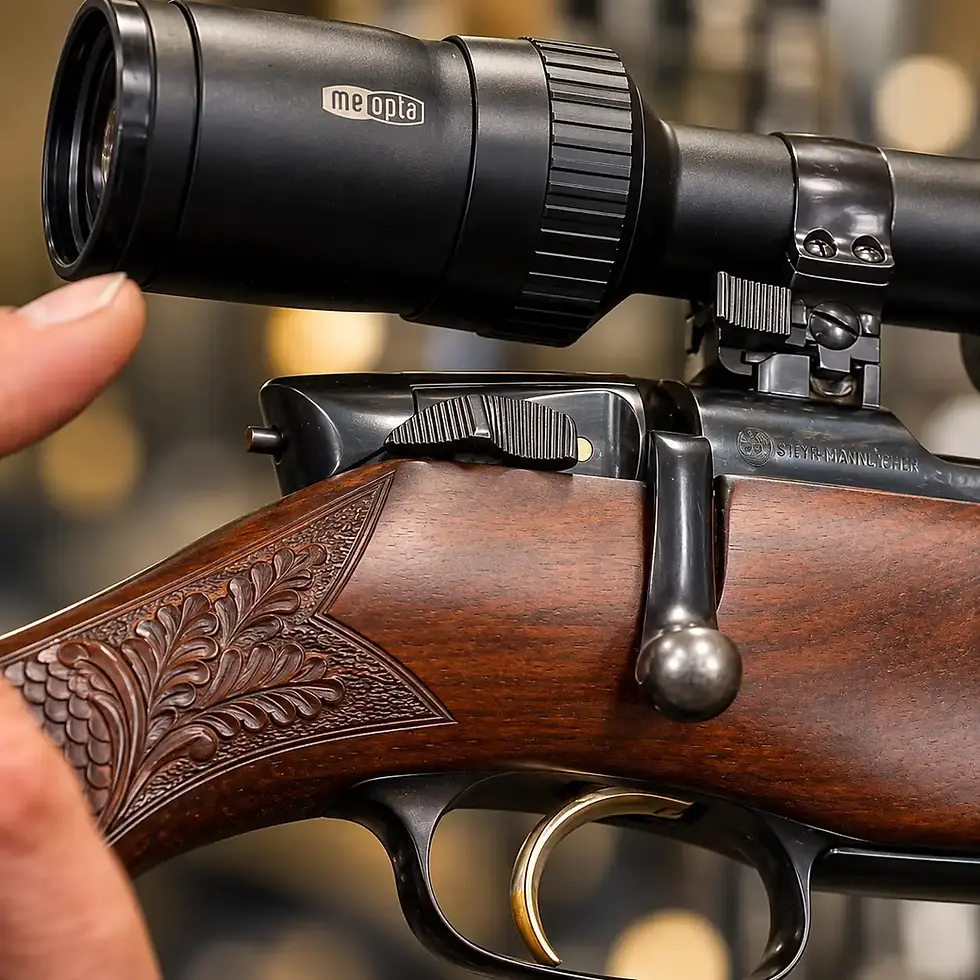
Beneath that beautiful walnut lies some fascinating engineering. The original Steyr Mannlicher Luxus features a bolt-action mechanism with six locking lugs that engage toward the rear of the receiver. One particularly interesting characteristic is that the entire bolt body does not rotate during operation. Instead, the bolt handle performs the rotational movement necessary to unlock the action. This arrangement contributes to the rifle's exceptionally smooth bolt operation. With a bolt lift of approximately 60 degrees, the design also provides sufficient clearance for operating the action beneath a low-mounted riflescope.
The Luxus was available with three different action lengths: L for shorter standard cartridges, M for longer cartridges, and S for powerful magnum cartridges. Consequently, Steyr offered the rifle in a broad range of chamberings. These included .243 Winchester, .308 Winchester, 7×64, .30-06 Springfield, .300 Winchester Magnum, and even the powerful 8×68 S. Several stock configurations were also available, including traditional half-stock rifles and full-stocked Stutzen carbines.
Another important difference between the Luxus and standard Steyr-Mannlicher rifles of that period was the magazine. While the regular models incorporated synthetic magazine components, the Luxus received a detachable steel magazine holding three cartridges. An optional six-round magazine was also available for driven hunts.
The Single-Set Trigger Has Its Quirks
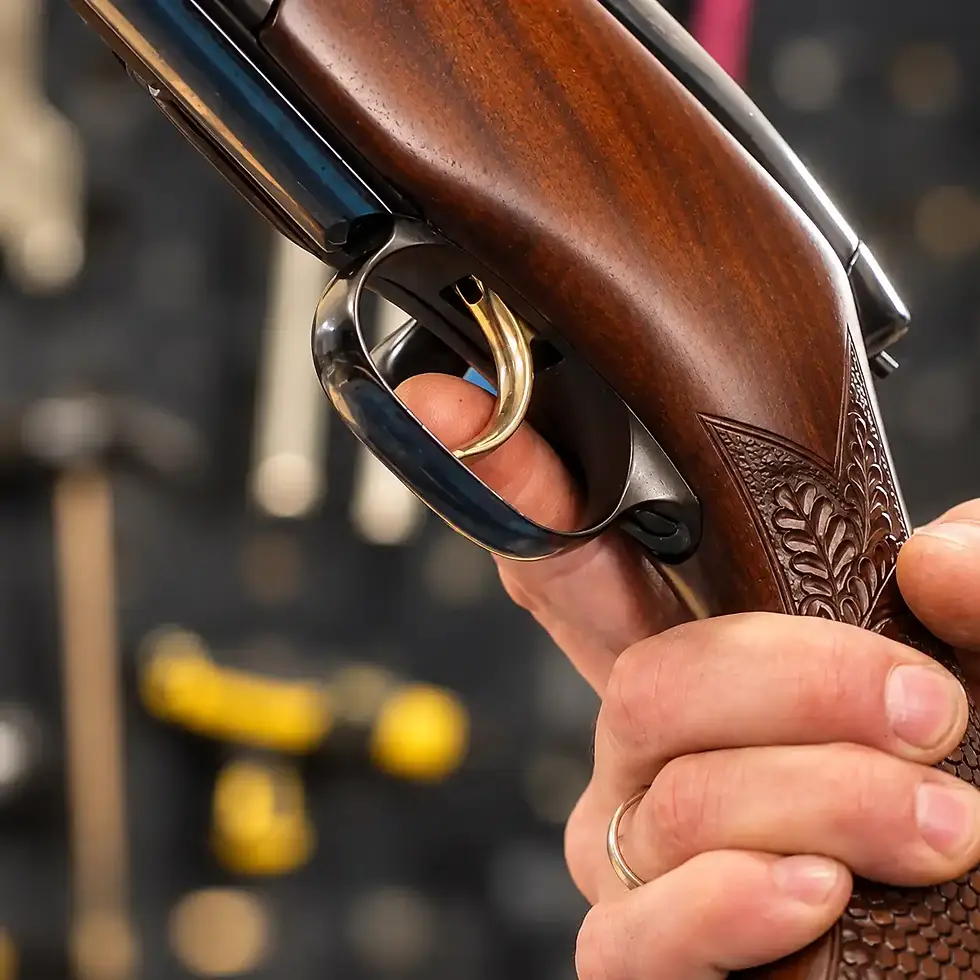
Our test rifle, chambered in .243 Winchester, belongs to the early production generation and still features the original side-mounted sliding safety. Later Luxus models were equipped with a roller-style safety positioned at the wrist of the stock. Another distinctive feature is its French-style single-set trigger, known in German as a Rückstecher. Unlike the traditional German double-set trigger, this system uses only one trigger blade.
David knows the characteristics of this mechanism particularly well from his daily work as a gunsmith. Occasionally, customers bring older Steyr rifles into his workshop because the set trigger no longer releases reliably. Worn or fatigued components can sometimes be responsible.
More often, however, David encounters problems related to the way the trigger is operated.
When the set trigger is touched from the side rather than pulled properly from the front, it may fail to release as expected. A small leaf spring inside the mechanism can also lose tension after decades of use. Fortunately, this component can be replaced by a qualified gunsmith.

A Cold-Hammer-Forged Barrel With Character
One of the trademarks of older Steyr rifles is the distinctive exterior finish of their cold-hammer-forged barrels. The characteristic spiral pattern isn't merely decorative. It is a visible result of the manufacturing process.
"That's something I really miss on today's Steyr rifles," David says. The original barrel on our test rifle has been shortened to approximately 52 centimeters during its lifetime. It has also been fitted with an M13×1 muzzle thread.

Putting the Old Lady to the Test
For our range session, the Steyr Mannlicher Luxus is equipped with a Meopta riflescope and a Hausken suppressor. Despite its shortened barrel and decades of use, the classic bolt-action delivers a convincing performance at 100 meters.
The rifle produces a respectable group, demonstrating that age alone is certainly no reason to retire a well-maintained hunting rifle. One thing becomes clear: This old Steyr is far from ready for the scrap heap. David also takes the opportunity to discuss the limitations of the .243 Winchester cartridge. For hunting European roe deer, the .243 Winchester has been a proven choice for decades. However, when it comes to larger game animals, particularly at extended distances, David takes a considerably more cautious approach. In his view, choosing the appropriate bullet, understanding its impact energy, and keeping shooting distances within responsible limits are essential. Hunters must also consider the applicable hunting regulations.
What Is a Steyr Mannlicher Luxus Worth Today?

Anyone searching for a well-preserved Mannlicher Luxus will quickly discover that these classic Austrian rifles still attract considerable interest. Examples in excellent original condition, particularly those featuring attractive walnut stocks, original components, and period-correct scope mounts, can command strong prices on the used market. David has been following the market for these rifles for years. For him, condition matters far more than age. A properly maintained rifle with a sound barrel and reliable mechanical components can remain a dependable hunting companion even after 40 or 50 years.
However, prospective buyers should inspect used examples carefully. Worn safety mechanisms, set-trigger problems, damaged stocks, or weakened extractor springs can result in additional expenses. Older scope-mounting systems deserve particular attention. Replacement parts and compatible upper rings for some traditional European mounts can be surprisingly expensive.
Fortunately, many of these classic rifles can still be professionally restored. Whether such work makes financial sense depends on the rifle's overall condition and the availability and cost of replacement parts.
A Hunting Rifle That's Hard to Replace
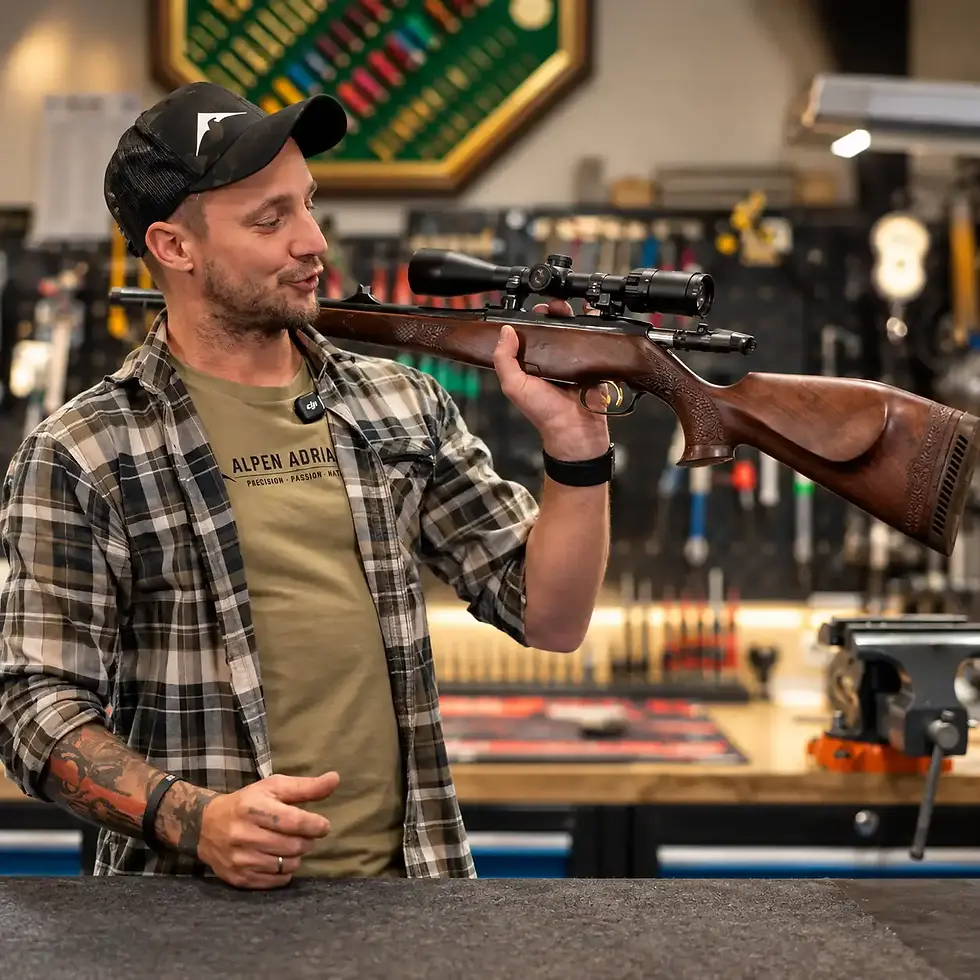
Of course, modern bolt-action rifles have their advantages. Many are lighter, feature updated safety systems, incorporate more weather-resistant stocks, and offer greater flexibility when mounting modern optics. But the Steyr Mannlicher Luxus doesn't necessarily need to compete with every new rifle on the market.
Its appeal lies in the combination of traditional gunsmithing, sophisticated engineering, and craftsmanship that continues to impress decades after the rifle left the factory. Watching David examine the old Steyr in his workshop, it quickly becomes obvious that his enthusiasm goes far beyond technical specifications.
It's about owning a rifle that feels right in your hands. A rifle you're proud to carry into the mountains. One that doesn't need to look brand-new because every scratch and mark tells a story of past hunts. The Steyr Mannlicher Luxus was no ordinary hunting rifle when it appeared in 1977. Nearly half a century later, it remains something special: A remarkable piece of Austrian firearms history that's still perfectly capable of accompanying a hunter into the field.


Comments