
The Silent — and Often Prohibited — Hunt with Bow and Arrow

There are hunting methods that feel as if they belong to another era. Bowhunting is unquestionably one of them. No thunder of a rifle shot. No smell of gunpowder. Just a drawn string, total concentration, and the quiet whisper of an arrow in flight.
Those who hunt with a bow enter an archaic bond with nature, one that reaches back to the very beginnings of human history.
Between Tradition and Modernity

For thousands of years, the bow was humanity’s primary hunting tool. Only with the spread of firearms did it fade into the background.
Today, bowhunting is experiencing a renaissance — particularly in countries such as the United States, Canada, Hungary, and France, as well as parts of Eastern Europe. In these regions, bowhunting is legal and tightly regulated.
In Austria and Germany, however, hunting with bow and arrow is currently not permitted, despite recurring public and professional debate.
The Psychology of Closeness
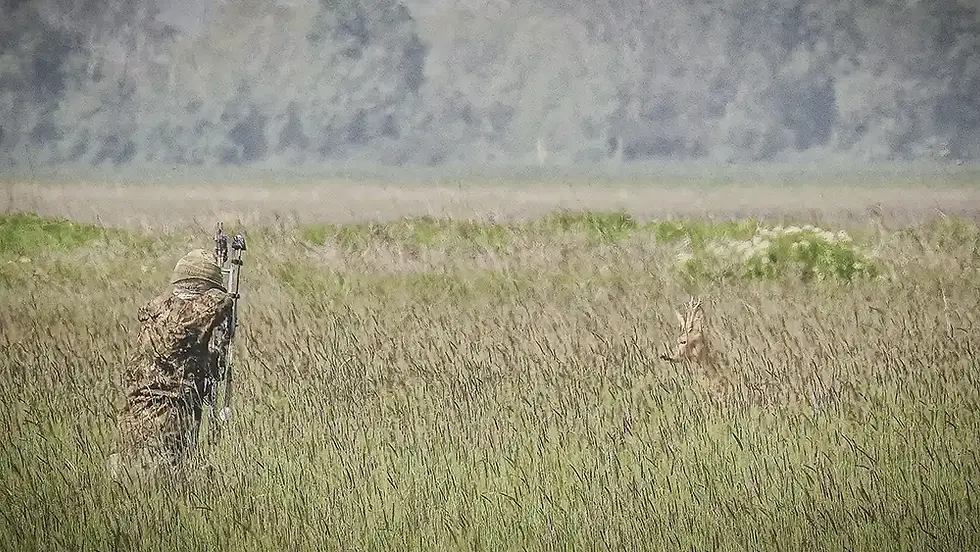
Unlike rifle hunting, bowhunting requires the hunter to close the distance to game — twenty or thirty yards, sometimes less.
This demands not only silent stalking skills, but inner calm and absolute control. Every muscle matters. Every breath counts.
When the bow is drawn, the hunter knows: a moment’s hesitation, a minor mistake — and the opportunity is gone.
It is precisely this intensity that makes bowhunting so compelling. It forces the hunter to be fully present, allowing encounters with wildlife at a closeness rarely possible with a rifle.
Technology and Responsibility

Modern compound bows equipped with precision arrows have little in common with the simple wooden bows of centuries past. They are highly engineered tools, capable of remarkable penetration and accuracy.
Still, the central question remains:
Can an arrow deliver a quick, humane kill?
Supporters point to studies showing that a well-placed arrow can be lethal and cause minimal suffering. Critics counter that errors in shot placement may lead to prolonged tracking and unnecessary animal suffering.
A Discipline for True Masters

Bowhunting is not an easy entry into the hunting world — it is arguably its most demanding discipline.
It requires deep knowledge of game behavior, unwavering patience, physical fitness, and continuous practice.
When releasing an arrow, the hunter carries an exceptional level of responsibility — arguably greater than with a rifle.
Where Bowhunting Is Legal - and Under What Rules
Below is an overview of the most relevant, clearly documented regulations in Central Europe and nearby reference countries. While not exhaustive worldwide, this list covers destinations realistically relevant to Central European hunters.
France — Legal, with Mandatory Training and Equipment Standards
Status: Legal
Key rules: Mandatory bowhunting training organized by regional hunting associations; bows must be drawn and held by muscle power only; for big game, only cutting broadheads allowed (≥25 mm cutting diameter or ≥40 mm blade length); arrows must be marked with the hunter’s license number. Non-resident hunters with short-term permits are exempt from the training requirement.
Italy — Legal Nationally, Details Set Regionally
Status: Legal under national law
Key rules: The Italian Hunting Act (Law 157/1992) explicitly lists the bow as a legal hunting tool. Regional calendars and regulations determine where and which species may be hunted (e.g., selective hunting of wild boar or ungulates).
Denmark — Legal, Since 2024 Also for Large Ungulates
Status: Legal; as of January 1, 2024, permanently approved for red deer, fallow deer, and sika deer
Key rules: Valid hunting license plus bowhunting proficiency test; for large deer species, minimum arrow weight, ≥80 J kinetic energy, and fixed three-blade broadheads (≥25 mm); mandatory online shot and harvest reporting.
Finland — Legal, but Not for Moose or Bear
Status: Legal for small game and ungulates below moose size
Key rules: Minimum draw weight of 180 N; broadhead requirement (≥22 mm) for ungulates, wild boar, and mouflon; mandatory shooting test; national hunting license required.
Benelux — Political Breakthrough in 2025
Status: In principle approved
Note: The Benelux Council of Ministers adopted a common list of permitted hunting equipment in 2025, reportedly including bow and arrow. National implementation remains decisive.
Czech Republic — Not Legal
Status: According to the European Bowhunting Federation: Not possible.
Slovakia — Restricted to Enclosed Areas
Status: Legal only in fenced preserves
Key rules: Minimum draw weight ≥220 N (~50 lbs). Non-residents may hunt via organizers.
Poland — De Facto Not Legal
Status: Polish hunting law recognizes firearms only; bowhunting is not included as a legal hunting method.
Germany — Effectively Prohibited
Status: Shooting arrows or bolts at ungulates is prohibited, effectively excluding bowhunting from legally relevant species.
Switzerland — Prohibited
Status: Federal hunting regulations explicitly ban crossbows and bows.
Austria — Prohibited
Status: Provincial hunting laws list bow and arrow as prohibited hunting tools.

Hungary: A Special Case in Central Europe
Hungary has legally recognized bowhunting since the 1990s, treating it as a regular hunting method. In addition to the standard hunting exam, hunters must pass a specialized bowhunting test, including practical shooting at various distances.
For species such as red deer, fallow deer, roe deer, and wild boar, minimum draw weights of around 220 N apply. Crossbows remain prohibited.
Since 2023, youth hunters aged 16 and older may bowhunt under supervision.
As a result, Hungary offers hunters from neighboring countries — where bowhunting is banned — a nearby, legal opportunity to practice this traditional yet modern form of hunting.
What All Legal Frameworks Have in Common
Where bowhunting is allowed, three constants emerge:
Training — mandatory courses (France), proficiency exams (Denmark), or shooting tests (Finland).
Equipment standards — minimum draw weights and broadheads with defined cutting dimensions.
Documentation — arrow identification requirements (France) and shot/harvest reporting (Denmark).

Where Bowhunting Could Offer Practical Benefits Today
Central Europe faces recurring challenges: wild boar damage to agriculture, browsing pressure by deer in young forests, and wildlife conflicts near settlements. Where legal, bowhunting can help:
Urban-adjacent deer populations (Denmark, since 2024): The silent shot reduces disturbance and risk where rifle use is sensitive.
Agricultural hotspots (Northern Italy): Quiet, selective harvests near travel routes and bedding areas can complement limited firearm options.
Enclosed preserves (Slovakia): Bowhunting allows legally controlled trials with measurable data on shot effectiveness and tracking effort.
For Austria, Germany, and Switzerland, the legal ban remains clear. However, hunters seeking professional insight can still pursue bowhunting education domestically and gain practical experience in neighboring countries such as Hungary, France, Denmark, or Finland.



Comments