
Ticks Are Moving Higher Into Austria’s Mountain Hunting Grounds
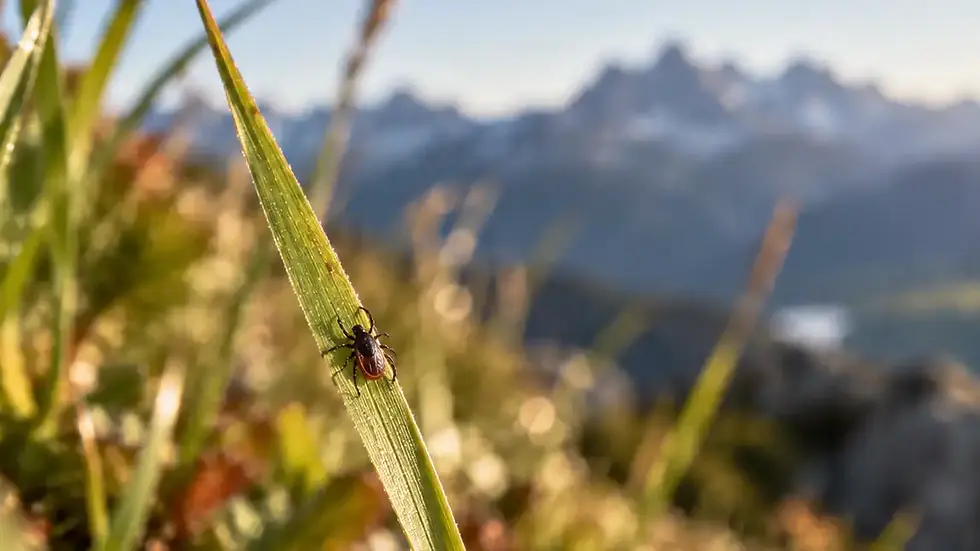
At 1,500 meters in a cool alpine forest, you would think ticks would no longer be much of a concern. Think again. In Austria, the castor bean tick is being found at increasingly higher elevations — and it is staying active for longer periods of the year. Climate change, milder winters, and wildlife acting as hosts are shifting its range. For hunters, that means tick country no longer ends at the edge of the lowland forest.
It is September. Heavy dew still clings to the grass as a hunter works his way uphill through the dwarf pines in the first light of morning. Elevation: 1,400 meters. Maybe 1,500. Chamois country. Cool air, mountain timber, alpine pasture. Ticks? Most hunters would expect them somewhere far below. That assumption may now be a mistake.
As red deer, roe deer, and chamois move between seasonal ranges, a tiny passenger is moving uphill with them: the tick. In particular, the castor bean tick, Ixodes ricinus, has expanded and shifted its habitat in recent decades.
The old rule of thumb that ticks are hardly a concern above 1,000 meters is outdated. Austria’s Agency for Health and Food Safety, AGES, has made it clear that this former elevation limit no longer applies. Individual ticks are now being recorded above 1,500 meters, while studies from the Alps have documented active Ixodes ricinus at elevations of roughly 1,700 meters and even above 1,800 meters.
Wildlife Is the Taxi
Of course, ticks are not climbing hundreds of vertical meters on their own. They hitch a ride.
Roe deer, red deer, chamois, ibex, foxes, rodents, and many other animals serve as hosts. A tick takes a blood meal, eventually drops off, and suddenly finds itself in a location it never could have reached under its own power.
Wildlife is especially effective at connecting different habitats. A roe deer may spend the morning in the valley and later move significantly higher. Red deer can cover even greater distances during seasonal migrations. Chamois, too, do not spend their entire lives above timberline.
In other words, wildlife becomes an unintentional transport system. But whether ticks can establish themselves permanently at a new elevation depends on more than animals alone. Temperature, humidity, vegetation, and the length of the growing season all matter. And that is where the alpine environment is changing.

Milder Conditions Higher Up
Ticks require moisture and sufficiently long periods of warmth to complete their development. Rising temperatures can therefore make higher elevations suitable in places that were once simply too cold or hostile. Austrian health authorities have pointed out that rising temperature totals in alpine areas can favor tick development. There is another change as well: the traditional tick season is becoming harder to define.
Even the German name for tick-borne encephalitis — literally “early summer meningoencephalitis” — can create the false impression that the danger disappears once July arrives. It does not. Under suitable conditions, ticks can remain active far beyond summer. AGES now notes that ticks can, in principle, be encountered year-round in Austria. In 2026, the first specimens were reported as early as the beginning of February.
For hunters, that matters. Our busiest months in the field do not necessarily begin with the first warm days of May. Stalking, the rut, tracking wounded game, recovering animals, habitat work, and driven hunts can keep us moving through tall grass, ferns, blueberry patches, blackberry tangles, young timber, and thick cover well into fall. In other words, exactly where ticks are waiting.
Hunters Make Ideal Hosts

ChatGPT kann Fehler machen. Prüfe wichtige Infos.
Ticks do not drop from trees. The castor bean tick usually waits close to the ground on grass, low vegetation, or brush. When a potential host passes, it transfers onto clothing or skin and begins searching for a suitable place to attach. Few people give it more opportunities than hunters do.
We do not stay on hiking trails. We push through young forest growth. We kneel in wet grass. We sit along timber edges. We crawl beneath branches. We drag and carry harvested game through thick vegetation. During a tracking job, we often go directly into the cover recreational hikers deliberately avoid. Then there is exposure time.
A hiker may be outside for two hours. During hunting season, a hunter may spend entire days — and sometimes nights — in the field. More time in tick habitat simply means more opportunities for contact.
Nearly One in Four Tested Ticks Carried Lyme Bacteria
Recent Austrian monitoring data shows just how relevant that risk has become. In 2025, a total of 8,298 ticks collected in Austria were submitted to AGES as part of the country’s national tick-monitoring program. Ninety-six percent belonged to the genus Ixodes, which includes the castor bean tick. Of 3,838 native hard ticks examined more closely for different pathogens, 24 percent carried Lyme borrelia bacteria. Researchers also detected organisms including Rickettsia and Anaplasma, among others.
That does not mean one in four tick bites results in Lyme disease. But it does show how common potentially infectious pathogens are in the environment. There is also an important distinction between two of Europe’s best-known tick-borne diseases.
The virus that causes tick-borne encephalitis, or TBE, can be transmitted almost immediately when the tick bites. Lyme disease bacteria generally require more time before transmission occurs. That means removing an attached tick quickly can reduce the risk of Lyme infection.
For TBE, however, there is an effective vaccine. All of Austria is considered a TBE risk area. No Austrian state is regarded as free of the disease, and Austria’s national vaccination recommendations therefore advise immunization for people living in the country.
For anyone who spends a significant portion of life in the woods — whether professionally or because hunting is a passion — checking vaccination status should arguably be as routine as checking a rifle, optic, or backpack before the season.
After the Hunt, Check Yourself

One of the most effective precautions is also one of the simplest: Check yourself after every trip into the hunting grounds.
Not the next morning. After every outing.
Pay particular attention to the backs of the knees, groin, armpits, stomach, back, neck, and hairline. Hunting pants and other clothing deserve a close look as well. A tick does not necessarily attach immediately. It may crawl around on clothing or skin for quite some time before finding a suitable place to bite.
If an attached tick is found, it should be removed as soon as possible with fine-tipped tweezers. Grip it as close to the skin as possible at the mouthparts and pull upward with steady pressure.
If a spreading, ring-shaped rash develops afterward — or if fever, severe headache, body aches, or other unusual symptoms appear — medical evaluation is warranted.
The New Reality of the Mountain Hunt
There is no reason for panic. But there is every reason to pay attention. Perhaps the most remarkable part of this story is not that ticks are now being found at 1,500 or 1,800 meters.
It is how quickly an old certainty has disappeared. “Ticks don’t live this high.” Generations of mountain hunters heard some version of that statement.
Today, it is no longer true. The castor bean tick does not suddenly disappear as elevation increases. It generally becomes less common — but its upper range is shifting. Where temperature, humidity, vegetation, and sufficient hosts come together, a tick carried into new country may eventually become part of an established population. Wildlife helps make that possible.
So perhaps the tick is no longer waiting only in the grass below. In a very real sense, it may already be riding uphill on the back of the roe buck, red stag, or chamois we follow into the mountains every fall. The tick follows the game. And sooner or later, it follows the hunter too.


Comments