
Carbon Country: How an Austrian Mountain Hunter Is Making Hunting Gear Lighter

Morning fog drifts through the spruce forests of Austria’s Flattnitz plateau. At more than 4,500 feet above sea level, where red stags and Alpine chamois are part of everyday life, innovative hunting gear is taking shape far from any corporate headquarters. There are no sterile research labs here. No marketing departments. No focus groups. Just a workshop, a mountain hunter, and a relentless drive to build better equipment.
Christian Fleischhacker greets us with a firm handshake. The 35-year-old engineer, mountain hunter, and lifelong tinkerer spends much of his time in the rugged terrain of the Austrian Alps. Not surprisingly, that’s exactly where his ideas are born. “Many products today are designed on a computer,” Fleischhacker says while picking up one of his carbon shooting sticks. “Mine are developed in the mountains.”
His company, HEP Carbon—short for High End Precision Carbon—has grown from a personal passion project into a brand whose products are now used by mountain hunters around the world.
The Pursuit of the Perfect Shot
Like many great ideas, it all started with a problem. As a young boy, Fleischhacker often accompanied his uncle on hunting trips. Long before shooting sticks became common, his uncle relied on them to ensure stable shooting positions and ethical kills. “He always said that a safe, accurate shot is the foundation of ethical hunting.”
Later, Fleischhacker began hunting with traditional wooden shooting sticks. While functional, they never fully satisfied him. “Wood has its limits. It’s heavier, noisier, and less rigid.”

Thanks to his academic background in wood and natural fiber technology, he understood the potential of advanced materials. It quickly became clear that if maximum stiffness and minimum weight were the goal, carbon fiber was the answer. So he started experimenting.
His first prototypes were little more than simple carbon tubes. Countless tests followed as he refined wall thicknesses, fiber types, and connection systems. Today, HEP Carbon products use high-strength carbon fiber with wall thicknesses ranging from 1.5 to 2.2 millimeters, depending on the application.
One challenge stood out above all others: noise.
Mountain hunters know that every sound matters. While carbon can sometimes produce a sharp, hollow noise, Fleischhacker developed specialized coverings that make his sticks remarkably quiet while also improving grip and comfort during cold-weather hunts.
From Shooting Stick to Mountain Staff
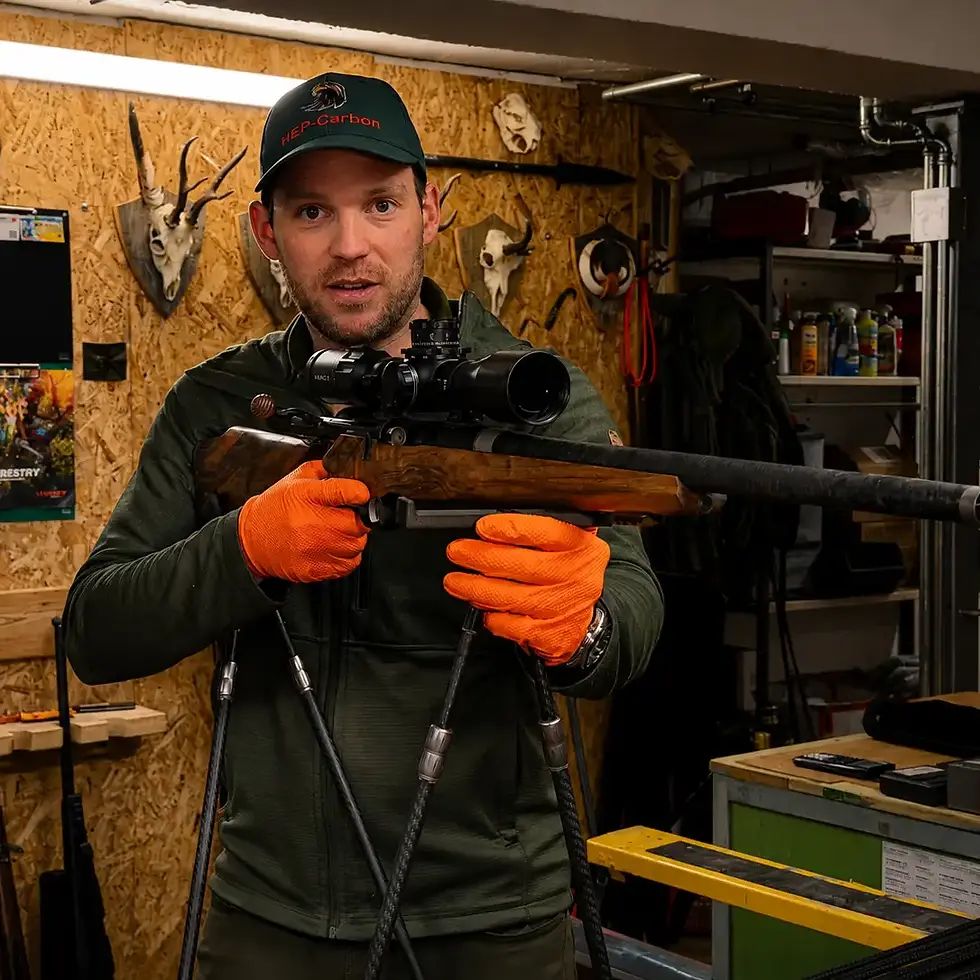
Inside his workshop, Fleischhacker shows us two of his flagship products: the Ultralight Silent and the Ultimate Flexible. Designed as both trekking staffs and shooting supports, they serve two critical purposes in mountain hunting: helping hunters navigate difficult terrain and providing a stable shooting platform when the moment of truth arrives. The most intriguing feature of the Ultimate Flexible is its optional fifth leg.
t first glance, it seems unusual. In the field, however, it proves to be a brilliant solution. The additional carbon support attaches via a neodymium magnetic system and creates an exceptionally stable shooting position. “If speed is critical, I leave the fifth leg packed away,” Fleischhacker explains. “For longer shots, I can attach it in seconds.”
Additional features include tungsten tips for rocky terrain, silent polymer tips for stalking hunts, and multiple length and breakdown options. The Austrian innovator also produces mountain staffs in two-piece, three-piece, and even hybrid configurations that combine trekking poles and hunting staffs into a single system.

When Every Ounce Matters
After spending time in Fleischhacker’s workshop, one thing becomes obvious: Everything revolves around reducing weight. His mountain staffs are built from ultra-high-strength carbon blanks featuring wall thicknesses up to 2.2 millimeters. Titanium and aerospace-grade 7075 aluminum are used wherever maximum durability is required.
The goal is simple: maximum strength with minimum weight. Perhaps no product reflects that philosophy better than the Sherpa Carbon Pack Frame. For years, Fleischhacker searched for a load-hauling system that met the demands of modern mountain hunters. Traditional wooden frames were too heavy. Aluminum models weren’t much better.
So he designed his own. The result is an ultralight carbon pack frame featuring heavy-duty padding, modular storage options, and a load-carrying system optimized for hauling game meat. Unlike many conventional pack frames, harvested game can be carried horizontally, keeping the weight closer to the hunter’s center of gravity. “When you’re packing out game or hauling mineral blocks into the mountains, you immediately notice how important weight distribution really is,” he says.
Backpacks Built for Mountain Hunting
The same philosophy carries over into HEP Carbon’s backpacks. The larger Gladiator 46L and the smaller Light Pack were specifically designed for mountain hunting applications. Both are fully compatible with the Sherpa frame and feature innovative rifle-carry systems. The rifle can be carried either centered or offset and can be deployed with a single motion.
Perhaps most impressively, the packs remain fully accessible even while a rifle is secured. Bright orange interiors make gear easy to locate during low-light conditions, a practical detail appreciated by hunters who often find themselves hiking before dawn or after sunset.

Knives for Minimalists
Even HEP Carbon’s knives reflect Fleischhacker’s obsession with weight savings. The Elite Hunter and Ultralight models feature premium Böhler steels, carbon fiber handle scales, and minimalist construction.
Complementing the knives is a purpose-built bone saw featuring a titanium frame and K390 steel blade. The design philosophy remains consistent throughout the lineup: Use only as much material as necessary—and not a gram more.
Developed in the Field
By the end of our visit, it becomes clear why HEP Carbon products feel different. They are not born from market research or trend forecasts. They are born from experience.
Every product begins with a problem encountered during real hunts and is refined through extensive field use in the Austrian Alps. “I’m a hunter, a mountain hunter, and a tinkerer,” Fleischhacker says with a smile. “I enjoy solving problems.”
That mindset can be seen in every product HEP Carbon builds.
More than just a manufacturer of lightweight hunting equipment, HEP Carbon represents a philosophy: gear should earn its place in the mountains through performance, not marketing.
From shooting sticks and pack frames to backpacks and knives, one common thread runs through the entire lineup—uncompromising functionality, real-world practicality, and a relentless pursuit of improvement.


Comments