
Hunting as an Economic Engine: Why Austria’s Hunters Generate Nearly €800 Million Every Year
- Jul 8
- 4 min read

More and more people are purchasing hunting licenses in Austria every year. But the true value of hunting goes far beyond rising participation numbers. Behind every hunting lease, elevated stand, and wildlife food plot lies an economic powerhouse that creates jobs, supports rural communities, and contributes hundreds of millions of euros annually to Austria’s economy.
When most people think of hunting, they picture an early-morning deer stand, the roar of a red stag during the rut, or a quiet stalk through the mountains. Few associate hunting with economic output, tax revenue, or employment. Yet today, hunting has become one of the most important economic sectors in Austria’s rural regions.
From rifles and thermal optics to off-road vehicles, habitat management, and building hunting blinds, nearly every euro invested by hunters flows back into local businesses. Hunting is far more than a pastime—it is a significant economic engine.
Nearly €800 Million in Economic Impact
A landmark study by Austrian economist Prof. Friedrich Schneider was among the first to quantify hunting’s contribution to the national economy. According to his research, hunting generates approximately €731 million in annual gross value added.
With increasing investments, rising equipment costs, and a growing hunting community, the overall economic impact of hunting is now estimated at nearly €800 million per year.
In addition, hunting contributes roughly €126 million annually in direct taxes and social security contributions, while another €146 million in indirect taxes flows into public budgets.
Measured against Austria’s overall Gross Domestic Product, this share may appear modest. However, considering that this economic output is generated by only a small percentage of the population, its importance becomes much more significant.
More Hunters Than Ever Before
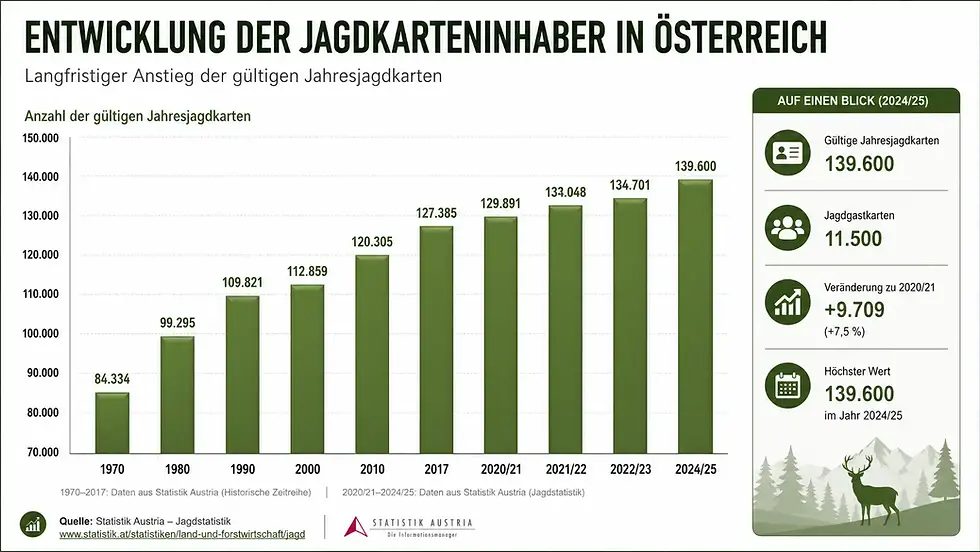
The latest figures from Statistics Austria confirm that hunting continues to grow in popularity. During the 2024/25 hunting season, approximately 139,600 annual hunting licenses were issued nationwide. An additional 11,500 guest hunting permits were also granted, setting yet another all-time record.
In just four years, the number of annual hunting licenses has increased by nearly 10,000, representing growth of approximately 7.5 percent. The trend reflects a growing enthusiasm for hunting, conservation, and sustainable wildlife management across Austria.
Hunters Invest Well Above Average

Hunting ranks among the country’s most expensive outdoor pursuits. Schneider’s original study estimated annual hunting expenditures at approximately €575 million. Since then, prices for firearms, premium optics, thermal imaging devices, ammunition, hunting apparel, and off-road vehicles have risen substantially.
Whether it’s cutting-edge thermal clip-on systems, suppressors, premium riflescopes, or specialized hunting vehicles, hunters continuously invest in high-quality equipment.
These investments support a wide range of businesses—from gunsmiths and firearm retailers to optics manufacturers, forestry companies, hunting outfitters, and skilled local craftsmen.
Habitat management represents another major area of investment. Hunters establish food plots, build elevated stands, maintain forest roads, and improve wildlife habitat. Much of this work is contracted to local businesses or carried out alongside regional tradespeople, creating additional economic value within rural communities.
Millions of Hours of Volunteer Conservation Work
One of hunting’s most overlooked contributions is the tremendous amount of volunteer labor provided by Austria’s hunting community.
Hunters dedicate countless hours to wildlife population surveys, habitat restoration, tracking wounded game, preventing wildlife damage, predator management, and caring for native wildlife populations.
Current estimates indicate that Austrian hunters contribute approximately 10.6 million hours of volunteer work every year. The economic value of these unpaid services is estimated at roughly €240 million annually. Without this commitment, many of these essential conservation tasks would have to be funded or carried out by public agencies.

Rural Austria Benefits the Most
Few industries are as closely connected to rural communities as hunting.
From small gunsmith shops and forestry contractors to hotels, restaurants, and hunting tourism, numerous businesses benefit directly or indirectly from hunting.
Current estimates suggest that hunting supports approximately 5,900 jobs across Austria.
Especially in economically weaker rural regions, hunting generates valuable income that remains within local communities and is reinvested in regional businesses.
More Than Just Numbers
While hunting’s economic contribution can be measured in millions of euros, its true value reaches much further. Hunters conserve wildlife habitat, invest in protecting native species, contribute millions of volunteer hours, and ensure that sustainable wildlife management remains possible for future generations.
The rising number of hunting licenses is therefore more than a statistic—it reflects a growing willingness among people to take responsibility for wildlife, natural resources, and the cultural landscape.
Hunting is far more than tradition or recreation. It is an essential pillar of rural Austria and an economic force whose importance is expected to continue growing in the years ahead.
Hunting in Austria - Key Figures (2024/25)
139,600 annual hunting licenses
11,500 guest hunting permits
Nearly €800 million in annual economic impact
€731 million in gross value added (Schneider Study)
€126 million in direct taxes and social security contributions
€146 million in indirect taxes
10.6 million volunteer hours each year
€240 million estimated value of volunteer conservation work
Approximately 5,900 jobs supported by the hunting sector
Sources: Statistics Austria (Hunting Statistics 2024/25), Hunting Austria (Jagd Österreich), Study by Prof. Friedrich Schneider.


Comments