
More Than Just Quiet: Why the .300 Blackout Could Change Modern Hunting

From Special Operations to the Deer Woods – What the .300 Blackout Really Brings to the Hunt Some hunters have trusted the .308 Winchester or .30-06 Springfield for generations. Others are embracing modern long-range performers like the 6.5 Creedmoor or .300 PRC. Then there’s the .300 AAC Blackout—a cartridge originally designed for military special operations that has steadily earned its place in hunting camps across Europe and beyond.
Few rifle cartridges have gained popularity as quickly over the past decade. Hunters who run suppressors or spend long nights pursuing wild boar and predators are increasingly discovering what this compact yet remarkably versatile cartridge has to offer.
But is the .300 Blackout truly a game changer, or is it simply another passing trend?
For Shot & Stillness, firearms expert David Mischkulnig of Alpen Adria Jagd in Villach, Austria, put the Ruger American Ranch chambered in .300 Blackout through an extensive field test and explains why it has become one of his favorite hunting setups.
A Cartridge Born for Special Operations
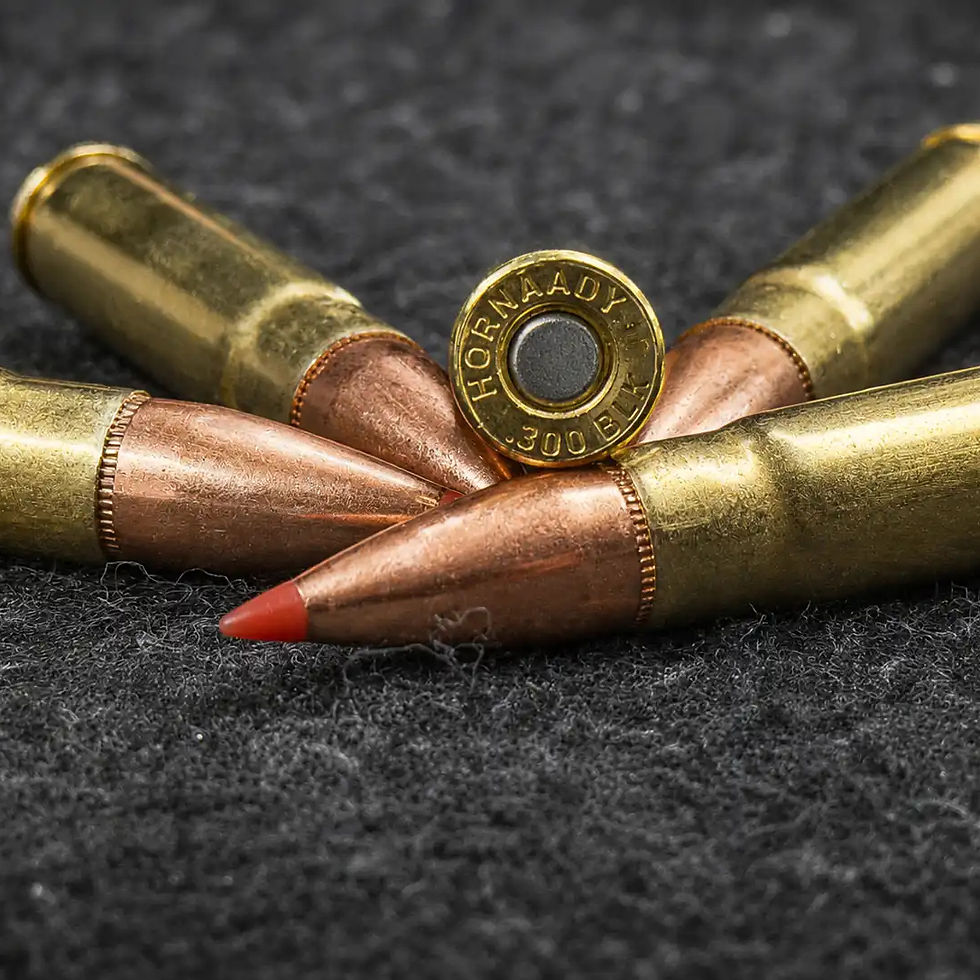
In 2009, Advanced Armament Corporation (AAC) and Remington Defense developed the cartridge specifically for U.S. military special operations. Their objectives were clear:
Maximum performance from short-barreled rifles
Seamless function in AR-15 platforms
The ability to switch effortlessly between supersonic and subsonic ammunition
Compatibility with existing AR magazines and bolt assemblies
Its greatest innovation lies in its design.
The .300 Blackout is based on the 5.56 NATO/.223 Remington case, shortened and necked up to accept a .30-caliber bullet. As a result, most AR-15 rifles require only a barrel swap, while the bolt and magazines remain unchanged.
Smaller Case, Much Heavier Bullet
This is where the .300 Blackout truly separates itself from the .223 Remington.
While a typical .223 fires bullets weighing between 55 and 77 grains, the .300 Blackout launches significantly heavier projectiles.
Common hunting loads include:
110-grain Hornady V-MAX
125-grain hunting bullets
150-grain soft points
190- to 220-grain subsonic loads
David Mischkulnig explains: “Compared to the .223, the biggest advantage is obvious. I can shoot subsonic ammunition while still delivering meaningful energy because I’m using a much heavier .30-caliber bullet.” That additional bullet weight allows the cartridge to retain surprising momentum—even below the speed of sound.

Built for Short Barrels
Modern hunting rifles continue getting shorter, largely because suppressors add considerable overall length.
That’s exactly the environment the .300 Blackout was designed for.
Unlike cartridges such as the .308 Winchester, which lose noticeable performance in shorter barrels, the .300 Blackout burns its powder efficiently in barrels as short as 9 to 16 inches.
Mischkulnig agrees.
“A 16-inch (40 cm) barrel is more than enough for the .300 Blackout. One hundred meters are absolutely no problem, and many of our customers confidently shoot out to 150 meters.”
Supersonic or Subsonic? Two Personalities in One Cartridge
Very few rifle cartridges offer such dramatically different applications.
Supersonic Loads
Using lighter bullets between 110 and 125 grains, supersonic .300 Blackout loads typically produce velocities between 650 and over 700 meters per second.
These loads are ideal for:
Roe deer
Predators
Wild boar at moderate distances
Their relatively flat trajectory allows ethical and accurate hunting shots out to roughly 150 meters.
Subsonic Loads
Subsonic ammunition is where the .300 Blackout truly stands apart.
These loads typically use 190- to 220-grain bullets traveling below the speed of sound—approximately 343 m/s (1,125 fps).
The result? No supersonic crack.
Combined with a quality suppressor, the rifle becomes astonishingly quiet.
Mischkulnig describes the experience: “With a good suppressor, you sometimes have to check whether the rifle actually fired. The sound of the bullet striking the target is often louder than the shot itself.”

The Biggest Misconception About the .300 Blackout
Many hunters automatically assume that quiet means weak. In reality, the opposite is often true. A 190-grain subsonic bullet still carries considerable momentum thanks to its weight. However, it also produces a much more pronounced bullet drop than supersonic ammunition.
During range testing, Mischkulnig observed that his subsonic load impacted approximately 12 centimeters (nearly five inches) lower at 50 meters than his rifle’s 110-grain V-MAX zero. His advice is straightforward: “You have to understand the cartridge. Subsonic isn’t just a quieter version of the same load—its ballistics and point of impact are completely different.”
Why Twist Rate Matters
Heavy bullets require fast rifling. That’s why many .300 Blackout rifles—including the tested Ruger American Ranch—feature a 1:7 twist rate.
This twist stabilizes both lightweight hunting bullets and heavy subsonic projectiles, making it one of the most versatile barrel configurations available.
As Mischkulnig explains: “The 1:7 twist is exactly what allows those heavy subsonic bullets to stabilize properly.”
Where the .300 Blackout Excels
The .300 Blackout is not intended as a long-range cartridge.
Instead, it’s a specialist.
Its strengths become obvious during:
Spot-and-stalk hunting
Wild boar hunting
Predator control
Tracking wounded game
Driven hunts
Suppressor-equipped hunting rifles
Dense forests are where the cartridge truly shines, especially during the hot summer months when deer spend most of the day under heavy cover. A lightweight rifle with a compact suppressor and .300 Blackout chambering is exceptionally fast, maneuverable, and easy to carry.
A Growing Selection of Hunting Ammunition
Not long ago, the .300 Blackout was considered a niche cartridge.
Today, virtually every major ammunition manufacturer offers dedicated hunting loads.
Among them are: Hornady, Sellier & Bellot, Fiocchi, Remington and Winchester.
Both supersonic and subsonic offerings continue expanding, reflecting the cartridge’s growing popularity among hunters worldwide.

Know Its Limits
No cartridge is perfect. The .300 Blackout is not a replacement for the .308 Winchester, particularly at longer distances. Beyond roughly 50 meters with heavy subsonic ammunition, bullet drop becomes significant and must be carefully accounted for.
Hunters should also verify that their chosen load meets local legal minimum energy requirements for the game species they pursue.
Another critical safety consideration involves ammunition compatibility.
Because the .300 Blackout shares the same parent case dimensions as the .223 Remington/5.56 NATO, cartridges and magazines can appear deceptively similar. A .300 Blackout cartridge must never be chambered in a rifle designed for .223 Remington or 5.56 NATO, as doing so can cause catastrophic firearm failure.
The .300 Blackout isn’t trying to replace America’s classic hunting cartridges.
Instead, it fills a role that few others can. It combines excellent short-barrel efficiency, outstanding suppressor performance, and the flexibility of both supersonic and subsonic ammunition—all in one remarkably compact package.
David Mischkulnig sums it up perfectly: “For specialized hunting applications, the .300 Blackout is an outstanding tool. You simply need to understand what it does well—and what it doesn’t.” And perhaps that’s the cartridge’s greatest strength. It isn’t the fastest. It isn’t the flattest shooting. But it may well be one of the most versatile hunting cartridges introduced in recent decades.


Comments