
The Mountain Eats Too: How Bedrock May Shape the Lifespan of Chamois
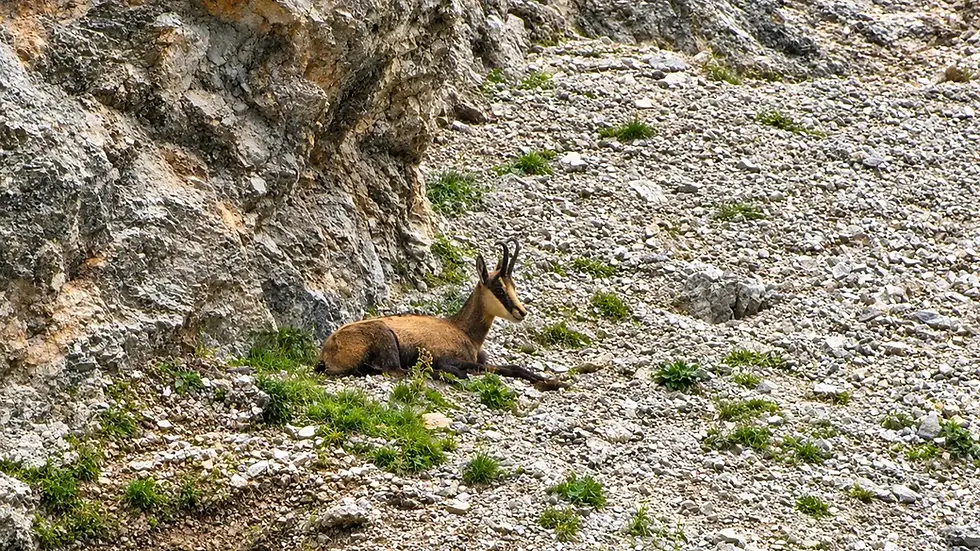
More than 31,000 harvested chamois, twelve hunting seasons, and 28 hunting districts: A new scientific study from the Alps reveals a relationship that has received surprisingly little attention. Depending on the geology beneath their feet, chamois may wear down their teeth at different rates — potentially affecting aging, body condition, and even population dynamics. For hunters and wildlife managers, this is far more than an academic curiosity.
Anyone who has hunted chamois for decades knows the classic factors used to evaluate a population: winter severity, forage availability, population density, disease, competition, sex ratio, and age structure. Climate change, too, is increasingly part of the equation.
Yet one factor that chamois literally spend their entire lives standing on is rarely considered: the mountain itself.
Not its steepness. Not its elevation. Its rock.
A study published in 2025 by Italian scientists Roberta Chirichella and Marco Apollonio suggests that the underlying geology of chamois habitat may help determine how quickly the animals physically age. And the connection between rock and longevity appears in a place few hunters would think to look: the teeth.
More Than 31,000 Harvested Chamois Studied
The scale of the dataset is remarkable. The researchers analyzed data from more than 31,000 Alpine chamois harvested across the central and eastern Italian Alps. The animals had been legally taken over twelve consecutive hunting seasons between 2010 and 2021 in a total of 28 hunting districts.
For 29,855 chamois, researchers had information including age and dressed body weight. In addition, they examined and measured the molars of 596 lower jaws. Of particular interest was the first molar — a tooth that performs a tremendous amount of mechanical work over the course of an animal’s life as it grinds and processes forage.
In a sense, hunting provided the biological archive for a study that would have been nearly impossible to conduct on a living population at this scale.
Researchers classified the animals’ habitats according to their underlying geology: limestone on one side, and silicate-rich or metamorphic rock on the other. What emerged was a striking pattern.
Chamois in the Hohe Tauern, left, and the Northern Limestone Alps, right.
Worth Knowing:
Limestone, Silicate-Rich and Metamorphic Rock — Simply Explained
Limestone consists primarily of calcium carbonate and forms many of the best-known mountain ranges and massifs in the Alps. Typical examples include the Dachstein, Hochschwab, Karwendel, and Julian Alps. Limestone mountains are often recognizable by their pale, rugged cliffs, karst plateaus, sinkholes, and caves. Common rock types include limestone and dolomite.
Silicate-rich rocks contain a high proportion of silicate minerals. Examples include granite, gneiss, quartzite, and mica schist. These rocks are widespread throughout the Central Alps, including the Ötztal Alps, Silvretta, Zillertal Alps, and parts of the Hohe and Niedere Tauern. They generally form different soils — often more acidic than limestone soils — and therefore support different plant communities.
Metamorphic rocks are rocks that have been transformed deep within the Earth’s crust by intense pressure and heat. Typical examples include gneiss, mica schist, quartzite, and marble. Large sections of the Hohe and Niedere Tauern, Ötztal Alps, Koralpe, and Kreuzeck Group consist of metamorphic rock.
One important point: “silicate-rich” and “metamorphic” are not opposites. Gneiss or mica schist, for example, can be both metamorphic and rich in silicate minerals.
Teeth Wear More Slowly on Limestone
Among chamois of the same age and sex, molars from animals living on limestone showed, on average, less wear than those from animals inhabiting silicate-rich or metamorphic terrain.
That does not necessarily mean limestone somehow gives chamois “better teeth.” Instead, geology alters the soil — and soil influences vegetation.
According to the researchers, plant communities growing on silicate-rich and metamorphic soils may contain higher levels of so-called opaline silica and can be mechanically tougher.
At the same time, the forage quality in these areas is described as lower. Over the years, chamois may therefore have to process vegetation that places greater mechanical stress on their grinding teeth.
On limestone, by contrast, the researchers observed slower tooth wear. At first glance, that may sound like little more than an anatomical detail. For an old chamois, however, it may help determine what happens next.
When the First Molar Is Worn Out
At some point, a tooth is no longer simply old — it begins to lose its function. This is where one of the study’s most intriguing findings emerges. The researchers found that the pronounced decline in physical condition began at roughly the point when the first molar had become heavily or completely worn down.
The consequence: The animals apparently became less efficient at taking in and utilizing forage. Body mass began to decline. That adds another dimension to what hunters mean when they talk about “an old chamois.”
Chronological age alone may not fully describe an animal’s physical condition. Two chamois can be exactly the same age yet be in very different biological states — depending on how far their teeth have already worn down. And that wear appears to depend, at least in part, on where the animal has spent its life.

Bucks Age Earlier
For chamois hunters, the difference between the sexes is equally interesting. The researchers found that physical decline associated with aging began earlier in bucks than in does.
On limestone terrain, the decline in body mass appeared in bucks at around 11 years of age, while in does it did not occur until roughly 16 years. On silicate-rich or metamorphic terrain, that threshold shifted forward to approximately nine years for bucks and 13 years for does. Those are substantial differences.
The researchers attribute this in part to the different life-history strategies of males and females. An old chamois buck pays a steep price for the rut every year. He must build reserves during the productive months, then burns through a significant portion of them just as the season turns toward winter — when forage becomes scarcer and environmental conditions increasingly harsh.
Does also invest tremendous amounts of energy in reproduction and raising young, but that energetic cost is distributed differently throughout the year. The data therefore support something experienced chamois hunters have long observed in the mountains: An old buck can lose condition dramatically in a relatively short period of time. What this study adds is the possibility that the condition of his teeth may be one of the key factors behind that decline.
Not Every Ten-Year-Old Chamois Is Biologically the Same Age
This is where the research becomes especially relevant to hunting and wildlife management. Traditionally, chamois are classified heavily according to chronological age. Their horns allow for an unusually accurate estimation of age compared with many other game species. An eight-year-old buck is eight years old — whether he lives on limestone, schist, or ancient crystalline rock.
Biologically, however, that does not necessarily mean the animals are in the same condition. The new study suggests that a buck living in habitat associated with greater tooth wear may enter senescence earlier than a buck of the same chronological age living somewhere else.
That raises an intriguing question for hunters and managers: Do rigid age-class boundaries really make equal sense in every chamois habitat?
The authors themselves point in this direction. They suggest that geology and the associated patterns of tooth wear should receive greater consideration in future adaptive management of chamois populations. Over time, that could potentially influence how harvest is distributed among age classes and how harvest quotas are structured.
There is, however, an important caveat. The results do not mean hunters should automatically harvest older chamois in limestone country and younger animals in silicate-rich terrain. The study neither tested nor developed such a generalized harvest strategy.
Instead, it provides another piece of the puzzle for understanding local chamois populations more precisely.
Looking Into a Chamois’ Mouth May Become More Important
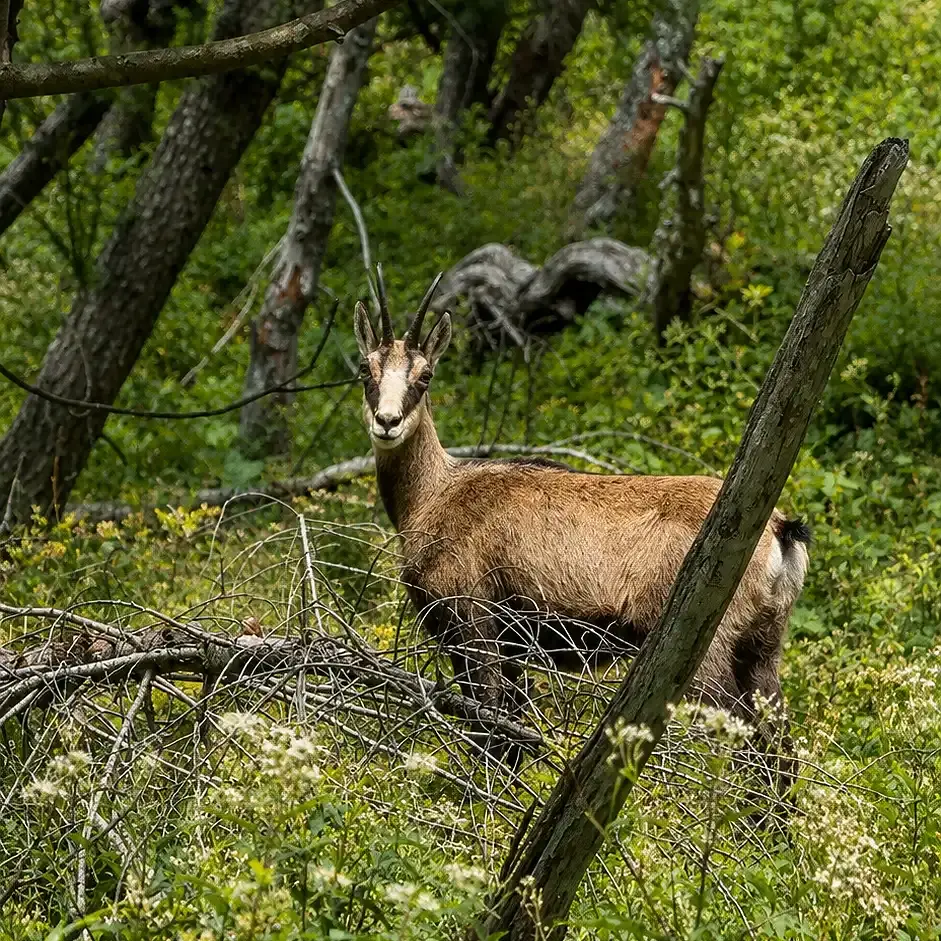
There is another potentially important lesson for hunters. The lower jaw of a harvested chamois may tell us far more about a population than we have traditionally asked it to. Horns are measured. Age is determined. Weight is recorded. In some areas, additional body-condition and health data are collected.
Systematically recording tooth wear could add another valuable layer of information. If managers knew, over a period of years, at what age the molars of a particular population reached certain stages of wear — and when body weights of older animals simultaneously began to decline — they might be able to determine much more precisely when chamois in a specific habitat truly become biologically old.
Not according to a textbook. But in that particular mountain range. That would be adaptive wildlife management in the truest sense.
Heavier Does Not Automatically Mean Better
nother detail from the study is important because it guards against oversimplification. Before the onset of senescence, chamois living on limestone were not necessarily heavier. In fact, animals from limestone habitats in the dataset had lower body weights before age-related decline than those from the combined silicate-rich and metamorphic areas. So the takeaway is not that limestone produces bigger or heavier chamois.
The key difference appears to be how rapidly functional tooth wear progresses and when age-related physical decline begins. For hunters, that is an important distinction. Body weight alone does not tell the full story of a chamois population.
The Mountain Shapes the Chamois for Life

Chamois are one of those game species in which the influence of habitat is immediately visible. A chamois living in a rugged limestone massif leads a different life from one moving through dark crystalline cirques, mountain pine, and high alpine grassland.
The possibility that these differences extend all the way down to the wear of individual molars adds an entirely new dimension to the concept of habitat quality.
The mountain determines which plants grow. The plants determine what a chamois chews year after year. And the rate at which those teeth wear down may eventually determine how efficiently the animal can continue to feed.
In the end, the study delivers a conclusion that will sound very familiar to experienced chamois hunters: You cannot understand chamois without understanding their mountain.
The mountain’s influence may simply reach farther than we once thought. Perhaps the aging of a chamois is shaped not only by hard winters, the rut, disease, or hunting pressure. Perhaps it is also decided day after day, bite after bite — by the very rock beneath its feet.


Comments