
Veteran Hunter Shares His Secrets for Successful Chamois Hunting

Chamois hunting during the rut and in December: Where your chances improve, which hunting strategies really work, and why brains often matter more than muscle in the high mountains. For chamois hunters, this is one of the most exciting — and challenging — times of the year. Bucks that remained virtually invisible all summer suddenly appear out of nowhere, while others disappear just as mysteriously. Successful hunting now takes more than exceptional fitness. It requires local knowledge, quality optics, and, above all, the right strategy. A seasoned Austrian chamois hunter shares his practical field-tested advice with Schuss & Stille.
These are the moments that make a mountain hunter get out of bed long before sunrise. A dark-coated chamois buck stands on a snow-covered rocky ridge. He scans his surroundings, moves a few yards, then stops to look around again. Below him, three females are feeding. Suddenly, another buck appears. Within seconds, the two are racing across a mountainside so steep that most people would struggle just to keep their footing. The chamois rut is in full swing. And while these remarkable mountain animals seem to defy gravity, the hunter faces a completely different challenge: How do you turn a chance encounter into a well-planned and successful hunt?
Strategy 1: Don't Look for the Bucks — Find the Females
The biggest difference between summer hunting and hunting during the rut is the behavior of the males. Outside the breeding season, chamois bucks often occupy their own preferred territories. But come November, everything changes. The males begin seeking out groups of females, commonly referred to as nannies. For hunters, that means changing the way they approach the mountain. Instead of concentrating exclusively on known buck territories, it pays to focus on slopes where female chamois regularly gather.
Large alpine basins, grassy ledges, and natural travel corridors between different feeding and bedding areas are particularly worth watching. Dominant bucks may hold certain areas for extended periods, while other males roam the mountains in search of receptive females.
Field Tip from a Veteran Chamois Hunter: Start keeping track of female groups and their preferred locations well before the rut begins. Don't just count the animals. Pay attention to the ridgelines, rocky outcrops, and natural crossings they use repeatedly. Those observations can become invaluable when the breeding season gets underway.
Strategy 2: Sometimes the Best Hunting Position Is on the Opposite Mountain

Patient observation often leads to success.
Anyone who has tried chasing a rutting chamois buck across the mountains in November will quickly learn one thing: Even the fittest mountain hunter is no match for a chamois. A much more effective approach is often to establish a good observation point on the opposite slope. From there, a quality pair of binoculars and a spotting scope allow you to glass large sections of mountain terrain without constantly changing position.
A seasoned chamois hunter explained his approach to Schuss & Stille: "I try to let the chamois come to me instead of chasing after them and creating unnecessary disturbance in their habitat." It's a simple statement that reflects decades of mountain-hunting experience.
During the rut, bucks may travel through the same area several times within a relatively short period. A hunter who has carefully selected a good observation point may therefore get several opportunities to study the same animal without rushing or disturbing the herd.
Field Tip: Before heading into the mountains, identify two or three promising glassing locations. Prioritize a wide field of view, minimal disturbance to the animals, and safe access and return routes. Spending several hours watching one productive basin is often far more effective than hiking endlessly from one ridge to another.
Strategy 3: Wind and Mountain Thermals Can Make or Break Your Hunt
A rutting chamois buck may be distracted by rival males, but that doesn't mean his sense of smell stops working. Wind conditions in alpine terrain can be notoriously unpredictable. Depending on sunlight, slope orientation, and weather conditions, rising thermals and descending cold air can shift within minutes. Add the swirling winds around ridges and narrow gullies, and things become even more complicated.
The traditional rule that air flows downhill in the morning and uphill during the day is therefore only a rough guideline.
Field Tip: Consider prevailing winds and local thermals before choosing your observation point, and monitor them regularly throughout the hunt. On days with highly variable wind conditions, it may be wiser to continue glassing from a greater distance rather than risk disturbing a sensitive bedding area.

Strategy 4: Fresh Snow Changes the Entire Hunting Map
December marks the beginning of real winter for alpine chamois. With every significant snowfall, the availability of natural forage changes. Steep, wind-scoured grassy slopes and sun-exposed mountainsides become especially important. In these locations, snow may slide off or melt more quickly, leaving patches of vegetation accessible while surrounding terrain remains buried beneath a blanket of white.
But here's the catch: Not every sunny mountainside is automatically good chamois country. Accessibility, natural cover, freedom from disturbance, and local snow conditions all influence where the animals choose to spend the winter. Forest-dwelling chamois may also behave very differently from animals living above the timberline.
Field Tip: After a major change in weather, study the snow distribution before deciding where to focus your observations. Where are patches of grass still exposed? Which slopes have been swept clear by the wind? Where has drifting snow accumulated? These details provide valuable clues about potential winter habitat. Fresh tracks can offer additional information, but they don't necessarily mean the animals are still nearby. Most importantly, wintering areas are not an invitation to repeatedly stalk the animals. Every forced escape burns precious energy reserves that chamois may desperately need later in the winter.
Strategy 5: Don't Overlook the Lone Bucks
During the peak of the rut, much of the action revolves around groups of females. By December, however, the situation may begin to change. As breeding activity gradually winds down, some bucks return to quieter territories. Older males in particular may withdraw from the intense rutting activity and settle into surprisingly small home ranges.
For an observant hunter, that means a solitary chamois on an otherwise unremarkable hillside may deserve just as much attention as a large herd. A quiet slope with some accessible forage and adequate natural cover can become more attractive in early winter than an expansive, exposed alpine basin. However, the rut isn't necessarily over everywhere by early December. Females coming into estrus later in the season and bucks still involved in breeding activity can continue to influence movement patterns.
Field Tip: Don't focus exclusively on large groups. Carefully observe solitary animals and keep records of repeated sightings. When evaluating a chamois buck's age, becoming familiar with the same animal over several days can be particularly valuable.
Strategy 6: That Dark Winter Coat Can Fool You
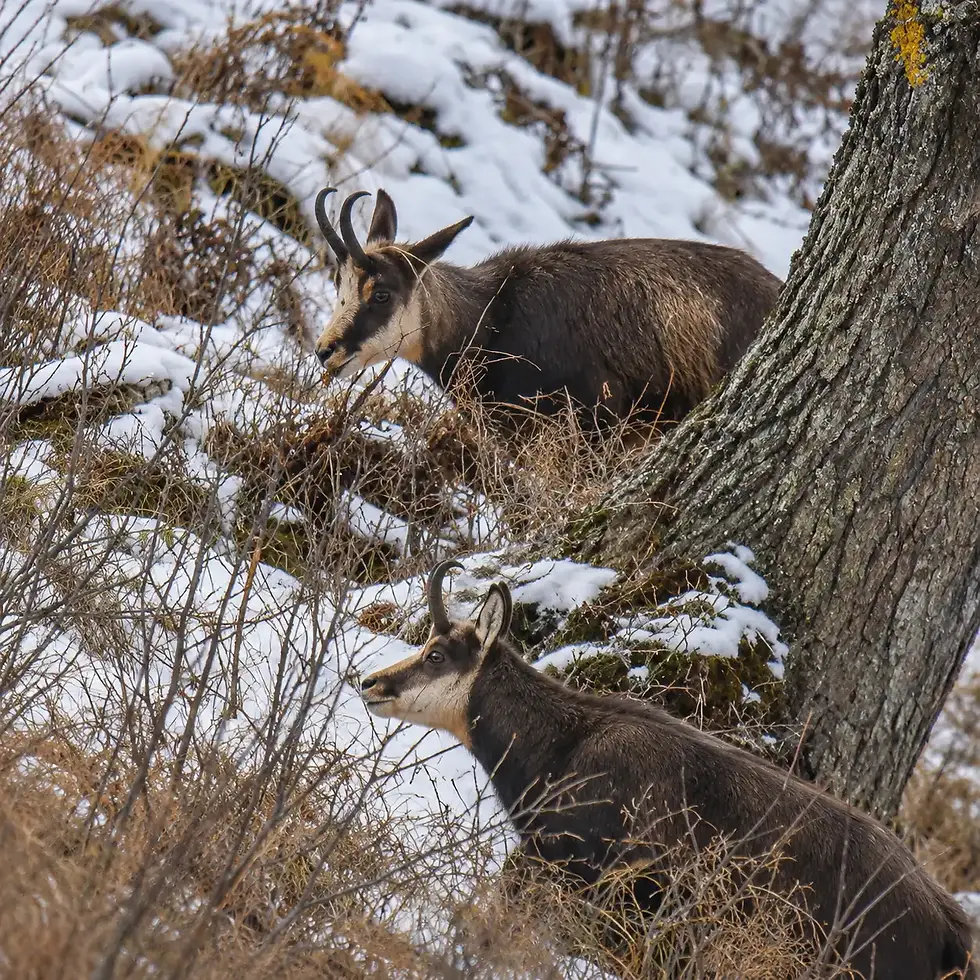
Determining the age of a chamois is one of the most demanding aspects of mountain hunting. In November and December, the animal's thick winter coat makes that assessment even more challenging. A heavy neck, pronounced chest, and powerful body may suggest a mature buck. However, younger males can also appear surprisingly impressive when wearing their full winter coat.
The same applies to the horns. Horn length alone is not a reliable indicator of age. The curvature of the hooks, thickness at the base, and overall horn shape can help distinguish males from females, but they should never replace an assessment of the entire animal.
Experienced chamois hunters evaluate several characteristics together: body conformation, head shape, backline, coat, behavior, and the animal's interactions with other chamois. Distinguishing females with dependent young from those without can be even more difficult. Young chamois don't necessarily remain right beside their mothers at all times.
Field Tip: A high-quality spotting scope mounted on a stable tripod is one of the most valuable tools in chamois country. Never rely too heavily on a single physical characteristic. If the animal's age class, sex, or possible dependency of young cannot be determined with sufficient confidence, keep watching rather than taking the shot.
Strategy 7: Adjust Your Hunting Schedule to Winter Conditions
Hunters accustomed to seeing chamois primarily during the early morning hours in summer shouldn't automatically expect the same activity patterns in December. During early winter, cold temperatures, sunlight, snow cover, and energy requirements all influence when animals move, feed, and rest. On bitterly cold days, sun-exposed slopes may not become particularly active until later in the morning. Under different weather conditions, however, the pattern can change completely. There is no universally reliable time of day when chamois are most likely to be visible in December.
Field Tip: Compare observations made during multiple outings in the same hunting area. When do the animals move between feeding and resting periods? Which slopes do they prefer in sunshine, and where do they go under overcast skies? A simple hunting journal recording the time, temperature, wind, snow conditions, and wildlife sightings can reveal surprisingly useful patterns.
Strategy 8: Plan the Recovery Before You Ever Take the Shot
A chamois hunt doesn't end when the rifle fires. In the high mountains during winter, recovering a harvested animal can quickly become the most dangerous part of the entire hunt. A slope that was easily passable in the morning may be covered in ice by late afternoon. An innocent-looking gully may become hazardous because of wind-drifted snow. And while a hunter is concentrating on the chamois, the return journey can suddenly become a very long one.
The critical question isn't simply whether the animal can be positively identified and a safe shot presented. It's also whether recovering that animal would be reasonable and safe under the actual mountain conditions.
Field Tip: Before every winter hunt, check the weather forecast, avalanche bulletin, snow conditions, and remaining daylight. Plan your return route and possible recovery options in advance. When conditions are difficult, consider bringing an experienced hunting partner. Depending on the terrain, crampons, first-aid equipment, a headlamp, and reliable communication devices should all be part of your mountain safety plan. And if the conditions aren't right? Keep your trigger finger straight and off the trigger.

The Best Recipe for Chamois Hunting? Patience!
Chamois hunting isn't a race against the clock — and certainly not a race against the animals. It demands the ability to read mountain terrain, anticipate movement, and, above all, manage your own expectations. After all, the best buck isn't always standing where you expect to find him. And the longest climb doesn't necessarily lead to the most memorable hunting experience. Sometimes all it takes is a well-chosen observation point, a good spotting scope, and the patience to let the animals follow their own natural rhythm.


Comments